Sector(s)
Team Members
Project Team
Lead Agency & Drupal Development: PROGRESSIVE digital (Cologne) – Architecture, custom module development, Figma design system, UI/UX design, accessibility compliance, AI chatbot integration, contributed module development
Branding & Communication Design: mc-quadrat (Berlin) – Visual identity, brand communication, UX research, UI/UX design
Development Support: DevBranch – Frontend development, theming
University Collaboration: Dedicated web team, IT department, faculty representatives from all academic divisions
Visit the site
Visit the siteOrganizations Involved
Community contributions
PROGRESSIVE Drupal Distribution: Continuously enhanced for public sector and higher education requirements, providing a pre-configured, accessibility-compliant Drupal platform
Contributed Modules on Drupal.org: PROGRESSIVE digital maintains multiple contrib modules used in this project, including Progressive Accessibility Widget, Cookies Addons, Field Addons, View Addons, Fine Image Upload, Block title class, CountUp Formatter, A Simple Timeline, Unicode Soft Hyphens, and more – all freely available to the Drupal community
Drupal Association: Bronze Supporting Partner, actively investing in the sustainability of the Drupal ecosystem
Knowledge Sharing: Presentation at Drupal Cologne meetup, sharing insights from a large-scale public sector Drupal implementation
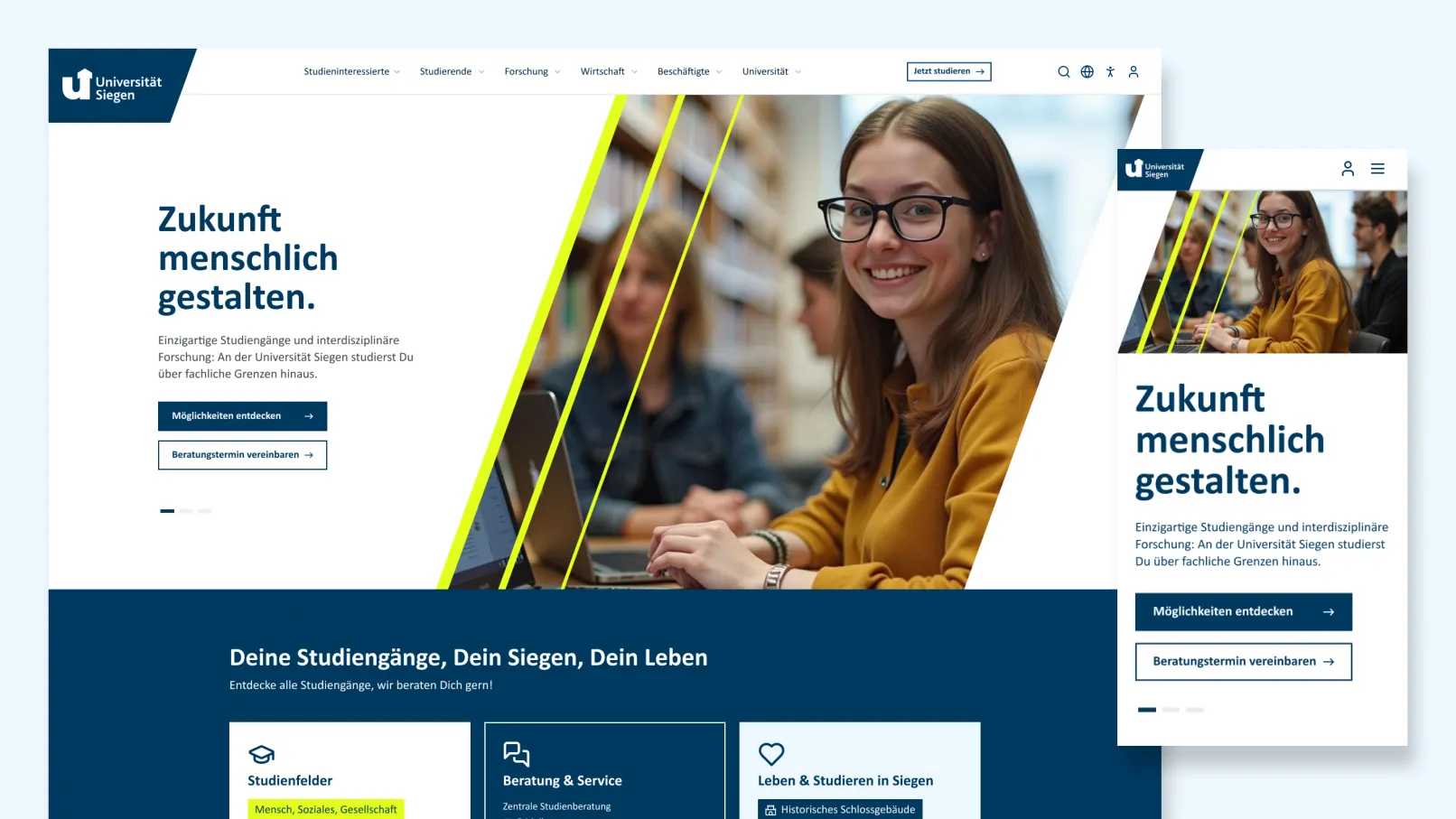
The University of Siegen is a major research university in North Rhine-Westphalia, Germany, with over 14,000 students and a complex organisational structure spanning multiple faculties, research centres, and administrative departments.
After two decades on a legacy CMS (XIMS), the university needed a modern, accessible web platform that could serve its diverse audiences – from prospective students and researchers to international partners and the general public. The project was one of the largest higher education web relaunches in the region.
PROGRESSIVE digital, a Drupal agency based in Cologne and Drupal Association Bronze Supporting Partner specializing in accessible, large-scale Drupal platforms for the public sector and higher education, led the project using the PROGRESSIVE Drupal Distribution – a pre-configured, accessibility-compliant Drupal platform built specifically for these sectors. PROGRESSIVE digital actively contributes to the Drupal ecosystem with multiple contributed modules on Drupal.org.
About the project
Goals
After two decades on XIMS, a proprietary CMS with no modern API, the university faced a migration of extraordinary complexity. Hundreds of thousands of pages had to be restructured while over 1,000 editors across faculties, institutes, and administrative units continued working without interruption. The deeply decentralized organizational hierarchy – from individual research groups to entire faculties – needed to be mapped into a granular permissions model. At the same time, the new platform had to integrate with the campus management system HISinOne for automated data synchronization, connect to the university's Shibboleth identity infrastructure, comply with European accessibility standards and the GDPR, and deliver high performance despite complex content structures.
Challenges
The project faced unique technical and organizational hurdles: migrating from a proprietary system with no standard export functionality, maintaining zero downtime for 1,000+ active editors, implementing complex academic hierarchies in a permission system, achieving full BITV 2.0/WCAG 2.1 compliance across all content types, and integrating multiple enterprise systems while ensuring data security and GDPR compliance.
Approach
The project followed an agile methodology with close collaboration between the university's web team and the development team. Key phases included stakeholder workshops to define content architecture, iterative UX design with accessibility testing at every stage, phased migration from the legacy system, and comprehensive editor training across all faculties.
Outcome
The platform was built on the PROGRESSIVE Drupal Distribution, a purpose-built framework for the public sector that standardizes accessible components, modular content logic, and central integrations. The project achieved zero editorial downtime during migration, full accessibility compliance, and integrated seamlessly with existing university infrastructure.
Key features
The platform delivers an AI-powered RAG chatbot with locally indexed university knowledge and specialized agents per service area. Automated role and rights management synchronizes with campus management data, eliminating manual user administration across the complex academic hierarchy.
Automatic translation via DeepL API with maintainable glossaries ensures consistent multilingual content, while a centralized media library provides copyright notices, usage guidance, and image rights management. Publication management through ORCID integration automatically displays research output per person, integrated into the university's organizational structure.
Performance optimization includes multi-layer caching, lazy loading, and automatic WebP conversion. GDPR-compliant cookie consent was custom-built with no third-party dependencies, ensuring full data protection compliance.
Editorial workflows span from draft to publish with content scheduling, revision history, and internal commenting. Personalized editor dashboards are scoped to each organizational unit, showing pending tasks and content status. H5P integration enables interactive learning content creation, while Dublin Core metadata management and broken link crawler maintain content quality.
What makes this project special
The sheer scale – 1,200+ organizational units, each with their own content needs and editorial workflows – required a platform that could balance central governance with local autonomy. The PROGRESSIVE Drupal Distribution provided this through modular content types, granular permissions, and a design system that ensures visual consistency while allowing organizational flexibility. Additionally, the platform is currently being extended with a RAG-based AI chatbot that answers from the university's own content instead of a general model, avoiding hallucinated responses.
Why Drupal was chosen
The university evaluated several CMS platforms including TYPO3, WordPress, and proprietary solutions. Drupal was selected for its enterprise-grade security, robust permission system, extensive accessibility features, proven scalability for large organizations, and strong ecosystem of contributed modules. Drupal's flexible content modeling and entity system made it ideal for mapping complex academic structures while maintaining performance and security standards required by European public institutions. The availability of the PROGRESSIVE Drupal Distribution – a pre-built, accessibility-compliant platform specifically designed for German public sector requirements – significantly accelerated the project timeline.
Technical Specifications
Drupal version:
Key modules/theme/distribution used:
- Layout Builder
- Bootstrap Layout Builder
- Paragraphs
- AI Agents
- AI Chatbot
- AI Search
- OpenAI / ChatGPT Integration
- Search API
- Translation Management
- Translation Management Auto Translate
- TMGMT DeepL Integration
- Accessibility Widget
- Workbench Access
- SAML Authentication
- h5p
- Editoria11y Accessibility Checker
- Progressive Accessibility Widget
- Matomo Analytics
- Cookies Addons
- Dashboard
- Scheduler
- Field Addons
- View Addons
- Frontend Editing
- Unicode Soft Hyphens
- Single Content Sync
PROGRESSIVE Drupal Distribution The PROGRESSIVE Drupal Distribution served as the project's foundation – a pre-configured, accessibility-compliant Drupal platform built specifically for German public sector and higher education requirements. It standardizes accessible components, modular content logic, and central integrations, significantly accelerating the project timeline for a relaunch of this scale.
Layout Builder and content architecture Layout Builder, enhanced with Bootstrap Layout Builder and custom restriction modules, gives editors maximum flexibility while maintaining design consistency across 1,200+ organizational units. Layout Builder Restrictions and Layout Builder Permissions ensure that faculty editors can create engaging pages without compromising accessibility or branding guidelines. Paragraphs provides the flexible content building blocks that underpin the university's diverse content types.
AI-powered chatbot and search The AI module suite (ai_chatbot, ai_agents, ai_search) with OpenAI integration enabled one of the first RAG chatbot implementations at a German university. Specialized agents serve individual service areas, while AI Search enhances content discoverability across the university's extensive content repository. Search API provides the foundation for both public content search and the chatbot's knowledge base indexing.
Advanced translation workflow TMGMT with DeepL integration automates translation while maintaining academic terminology accuracy through custom glossaries. This combination reduces manual translation overhead for content spanning multiple languages and academic disciplines – essential for an international research university.
Granular access control Workbench Access creates the sophisticated permission structure required for the university's academic hierarchy. Editorial rights are automatically assigned based on HISinOne campus management data while allowing manual overrides for student assistants and collaborative projects – mapping 1,200+ organizational units into a manageable permission model.
Enterprise authentication SAML Authentication integrates seamlessly with the university's existing Shibboleth infrastructure, providing single sign-on across all digital services – a critical requirement for the academic environment.
Interactive learning content H5P enables the creation of interactive learning materials directly within the CMS, supporting the university's educational mission beyond static web content.
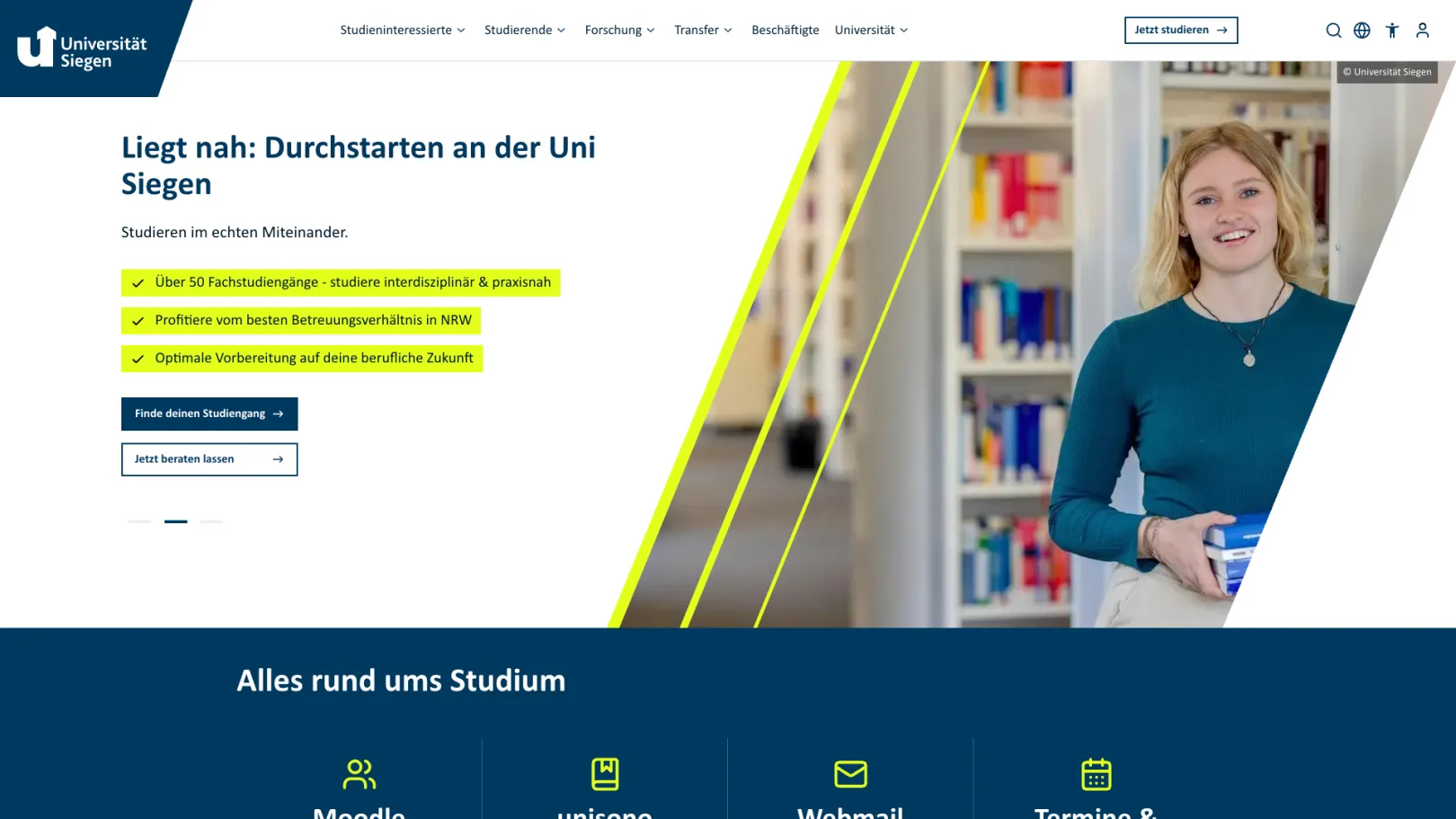
Accessibility compliance The Progressive Accessibility Widget, a GDPR-compliant Drupal integration of the forked Sienna Accessibility Widget with no third-party requests, allows visitors to adjust the site display to their individual needs, such as contrast, font size, and reading aids. Editoria11y provides inline accessibility checking and guidance for editors within the editorial interface. Together they support BITV 2.0/WCAG 2.1 AA compliance across both the public-facing and editorial experience.
Privacy-compliant analytics and cookie consent Matomo keeps all usage data within the university's own infrastructure, while Cookies Addons ensures GDPR-compliant consent management – both firm requirements for a German public institution.
Editorial workflows Dashboard provides personalized content management interfaces scoped to each organizational unit, showing pending tasks and content status for over 1,000 editors. Scheduler enables time-based publishing and unpublishing, supporting the editorial workflows spanning from draft to publication.