Sector(s)
Team Members
Project Team
Lead Agency & Distribution Development: PROGRESSIVE digital (Cologne) – Architecture, distribution framework, custom module development, accessibility compliance, AI integration, contributed module maintenance
UX & Design: mc-quadrat (Berlin) – User research, Figma design system, responsive UI/UX concept
Development Support: DevBranch – Frontend development, theming
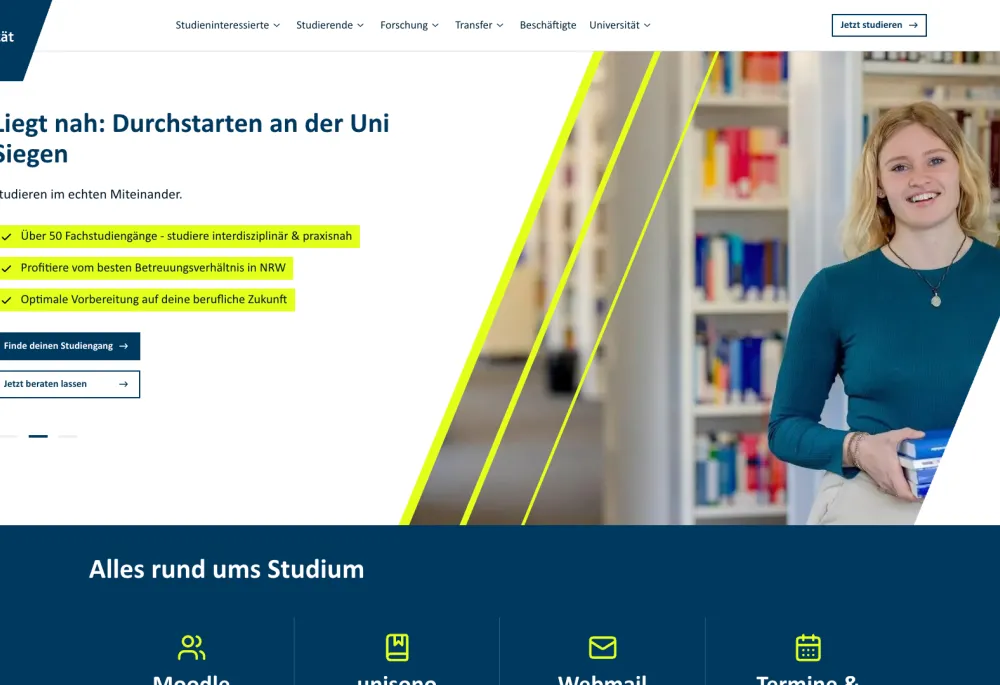
Flagship Partner: Universität Siegen – Web team, IT department, faculty representatives from all academic divisions
Visit the site
Visit the siteOrganizations Involved
Community contributions
Contributed Modules on Drupal.org: PROGRESSIVE digital maintains 13+ contributed modules freely available to the Drupal community, including Cookies Addons, Field Addons, View Addons, Fine Image Upload, Progressive Accessibility Widget, A Simple Timeline, Unicode Soft Hyphens, and more
PROGRESSIVE Drupal Distribution: Open-source platform continuously enhanced for public sector accessibility and compliance requirements
Drupal Association: Bronze Supporting Partner, actively investing in the sustainability of the Drupal ecosystem
Security Advisory Credits: Contributing to Drupal security through advisory credits for Block Attributes and Cookies Addons
Knowledge Sharing: Regular presentations at Drupal Cologne meetup, sharing insights from large-scale public sector implementations
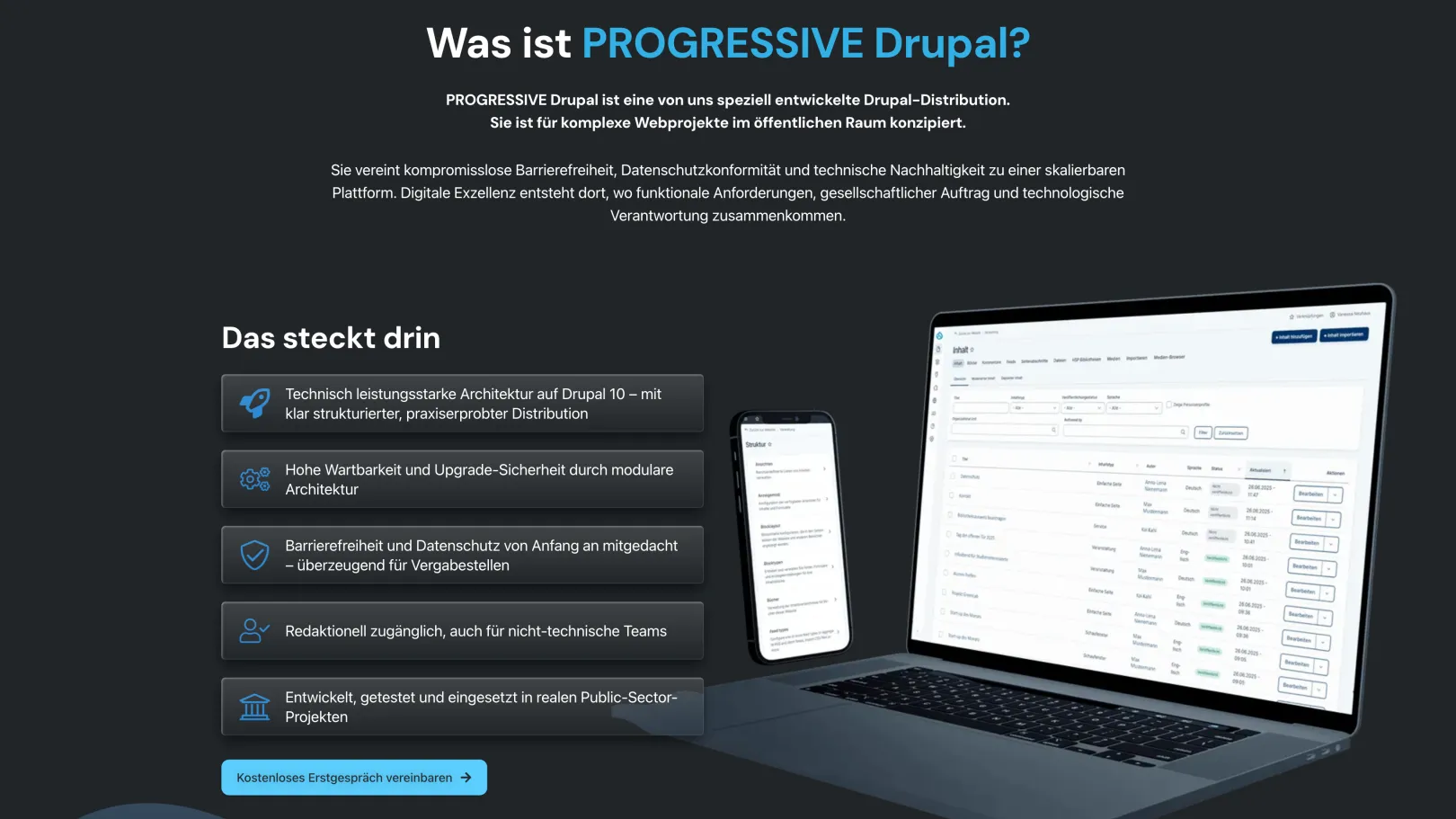
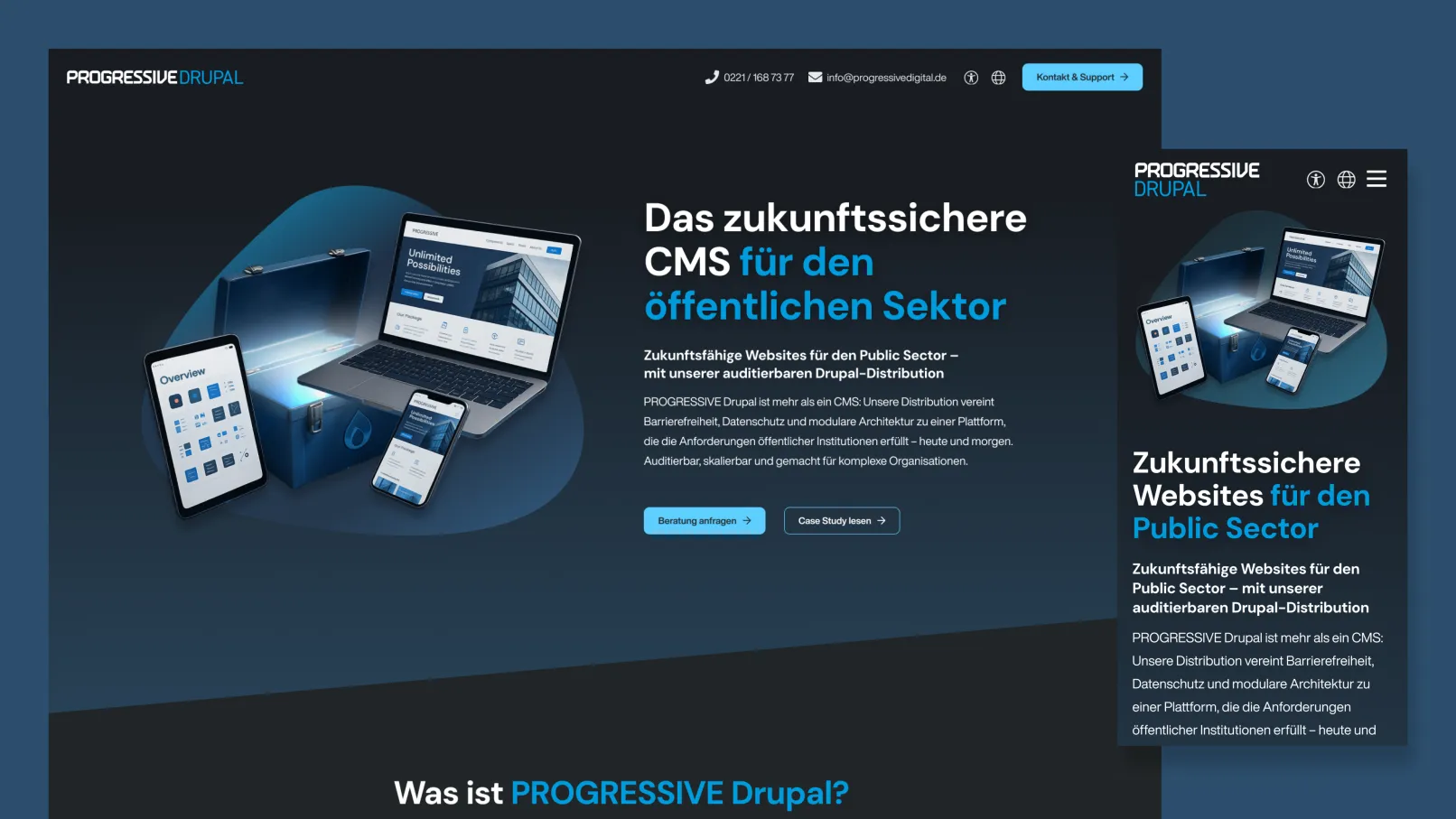
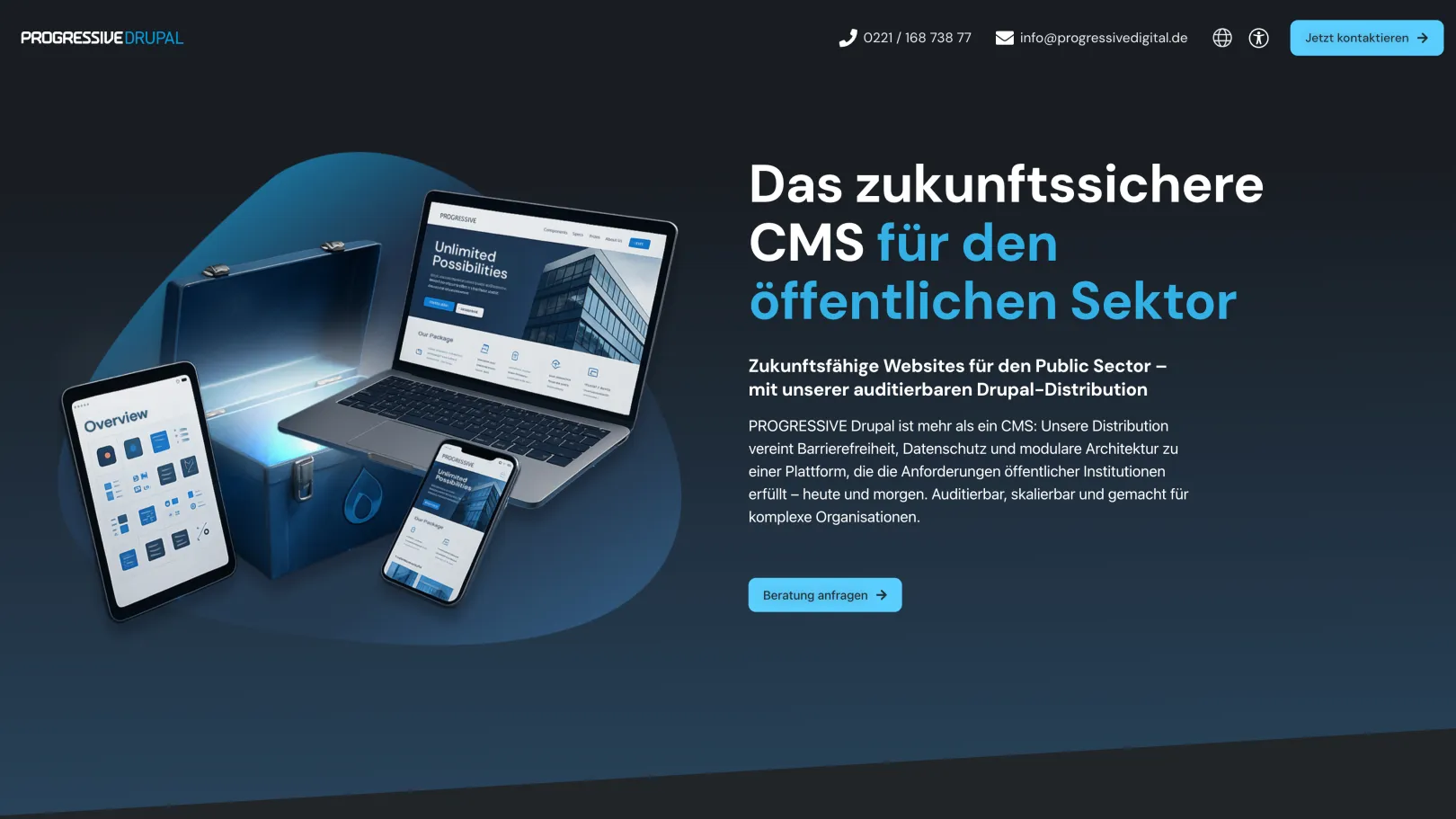
PROGRESSIVE digital is a Drupal agency based in Cologne, Germany, and a Drupal Association Bronze Certified Partner with over 20 years of experience in digital projects for the public sector. The PROGRESSIVE Drupal Distribution is their open-source platform built specifically for public institutions — combining mandatory accessibility standards, data protection compliance, and structured editorial governance into a single, auditable Drupal-based solution.
The distribution treats accessibility and compliance as system principles, not additions: accessible components are the default, editors receive real-time guidance, and compliance documentation is generated automatically. More than 20,000 editors work with the platform daily across universities, ministries, and public foundations in Germany. Its flagship deployment — Universität Siegen — migrated 100,000+ pages across 1,200+ organisational units to the distribution within 12 months.
As a Drupal Association Bronze Certified Partner, PROGRESSIVE digital offers implementation, migration, and long-term maintenance of the distribution — from initial accessibility audit through multi-site campus deployment. PROGRESSIVE digital actively contributes to the Drupal ecosystem, maintaining multiple contributed modules on Drupal.org including accessibility tools, editorial helpers, and compliance components.
About the project
Key results at a glance
- 20,000+ editors working with the distribution daily across institutions
- 100,000+ pages managed across universities, ministries, and public foundations
- BITV 2.0 / WCAG 2.1 Level AA compliant out of the box — not retrofitted
- Flagship deployment: Universität Siegen — 1,200+ organisational units, 1,000+ editors, migrated from XIMS in 12 months
What makes this project special
Most platforms treat accessibility and data protection as additions — features to enable, plugins to install, audits to survive. The PROGRESSIVE Drupal Distribution takes a fundamentally different approach: accessibility and compliance are system principles, not options.
Accessible components are the default. Editors receive real-time guidance within the interface. Compliance documentation is generated automatically for audits and procurement processes. Data protection works the same way — the platform avoids third-party integrations such as external fonts or tracking scripts by design, keeping data sovereignty fully within the institution.
All AI-powered features follow the same principle: genuinely useful capabilities — RAG-based chatbot, semantic search, automated translation — deployable entirely within institutional infrastructure. No data leaves the institution unless the institution decides otherwise.
Goals
Public sector institutions — universities, government agencies, public foundations — face a convergence of digital demands: mandatory accessibility compliance, strict data protection requirements, and the need to support thousands of editors across decentralised departments. Generic content management systems rarely meet all of these requirements simultaneously, forcing institutions into costly customisation or compliance retrofits before go-live.
The goal was to build a Drupal-based distribution that makes accessibility, data sovereignty, and editorial governance available out of the box — reducing implementation risk and shortening the path to a legally compliant, auditable, and sustainable web platform.
Challenges
Public sector projects in Germany operate under binding legal constraints: BITV 2.0 (the national Web Accessibility Directive implementation), the General Data Protection Regulation (GDPR), and the Accessibility Strengthening Act (BFSG). Meeting all three simultaneously, while supporting complex multi-department editorial structures with granular roles and approval processes, is both technically and organisationally demanding.
Legacy migrations from platforms such as TYPO3, XIMS, and FirstSpirit add further complexity, requiring careful transition planning to avoid disrupting editorial operations for hundreds or thousands of active editors.
Approach
The distribution was built iteratively, with each production deployment feeding improvements back into the platform. Implementations follow a structured rollout: content architecture workshops, iterative design phases with accessibility testing at every stage, and phased migrations that allow old and new systems to run in parallel.
All intelligent extensions — AI chatbot, automated translation, semantic search — are designed so that institutions retain full control over their data and infrastructure, with on-premise and private cloud deployment options throughout.
Outcome
Universität Siegen — previously running a 20-year-old XIMS installation with no accessibility compliance — migrated 100,000+ pages and onboarded 1,000+ editors across 1,200+ organisational units. Departments now manage their own content independently within a governed framework, and the platform passes BITV 2.0 audits without remediation.
Across all deployments, institutions gain a platform that meets accessibility standards from day one, is fully GDPR-compliant without external dependencies, and scales from individual departmental sites to multi-site campus deployments. Procurement teams can reference existing production deployments and documented compliance — significantly reducing evaluation risk for new institutions.
Key features
- Accessibility by default: Every interface element meets BITV 2.0 / WCAG 2.1 requirements. Automated and manual testing provides real-time editorial feedback. An optional user-facing accessibility widget gives visitors additional control.
- Editorial governance at scale: Granular role and permission management supports decentralised editorial structures, approval workflows, and documented processes — designed for organisations with hundreds of editors across dozens of departments.
- Data protection without compromise: Custom cookie consent without external scripts, with optional revision-secure logging. No external fonts, no tracking scripts, no third-party data transfer by default.
- AI that stays on-premise: RAG-based chatbot running on institutional infrastructure. Semantic search with relevance ranking, autocomplete, faceted filtering, and optional AI-generated direct answers. No data transfer to third parties required.
- Automated translation with editorial control: DeepL API integration provides machine translation as an editorial starting point, with structured review and approval workflows — including support for plain language (Leichte Sprache).
- Design system on a Figma foundation: Component-based, reusable content blocks with visual configuration within institutional corporate design. 1:1 from design to code.
- Proven migration paths: Tooling for TYPO3, XIMS, and FirstSpirit platforms, enabling phased transitions without editorial downtime.
- Infrastructure-ready: CI/CD pipeline support via GitLab, Docker, and Ansible — suitable for state and university data centres. Passes security requirements for government infrastructure.
Why Drupal was chosen
Public sector institutions in Germany typically evaluate TYPO3, WordPress, and proprietary CMS solutions. Drupal was selected as the foundation for the PROGRESSIVE Distribution because of its Drupal's open-source model was a non-negotiable starting point. Public institutions require full control over their codebase, data, and hosting infrastructure. Proprietary platforms introduce licensing dependencies and vendor lock-in that conflict with public procurement requirements and long-term platform planning. Drupal eliminates both.
Drupal's native permissions architecture made it the right foundation for complex organisational structures. Granular content ownership by department, decentralised editorial workflows, and scalable role hierarchies are handled by Drupal's core — without workarounds. This scalability, from a single faculty site to a full multi-site campus platform, is what public institutions require.
Drupal's API-first architecture enabled seamless integration with campus systems (HISinOne), library infrastructure, and SSO environments (Shibboleth) via REST and JSON:API — all essential for institutions that cannot operate in isolation from their existing technology ecosystem. Combined with Drupal's long-term release support and proactive security advisory process, this gave procurement teams and IT departments the reliability and transparency required for a strategic platform decision.
Technical Specifications
Drupal version:
Key modules/theme/distribution used:
- Layout Builder
- Bootstrap Layout Builder
- Paragraphs
- Leaflet
- Geofield
- Geocoder
- Translation Management
- TMGMT DeepL Integration
- COOKiES Consent Management
- Cookies Addons
- Frontend Editing
- Metatag
- Schema.org Metatag
- Pathauto
- Webform
- AI Chatbot
- AI Agents
- AI Search
- OpenAI / ChatGPT Integration
- Search API
- Editoria11y Accessibility Checker
- Workbench Access
- SAML Authentication
- Dashboard
- Progressive Accessibility Widget
- Cookies Addons
- Field Addons
- View Addons
- Fine Image Upload
- Block title class
- CountUp Formatter
- A Simple Timeline
- Slider collection
- Status pages
- Symfony Mailer Addons
- Translation Management Auto Translate
- Unicode Soft Hyphens
Flexible content architecture Paragraphs and Layout Builder form the editorial backbone of the distribution. Bootstrap Layout Builder and Bootstrap Styles give editors visual page composition within governed design boundaries. Layout Builder Restrictions and Component Attributes ensure engaging pages without compromising accessibility or branding.
Maps and geospatial content Leaflet, Geofield and Geocoder are enabled by default — from simple location maps to complex geospatial visualisations.
Translation with editorial control TMGMT with DeepL integration provides machine translation as an editorial starting point, with structured review workflows ensuring accuracy before publication. Custom glossary support maintains terminology consistency across languages, including Leichte Sprache.
Privacy-compliant cookie consent The Cookies module with Cookies Addons provides GDPR-compliant consent management without external script dependencies, keeping full data sovereignty within the institution.
In-context editing Frontend Editing allows editors to modify content directly on the published page.
SEO and discoverability Metatag and Schema Metatag provide structured metadata. Pathauto generates clean URLs automatically. Webform handles contact forms with built-in spam protection.
Accessibility by default The Progressive Accessibility Widget, developed by PROGRESSIVE digital, provides real-time accessibility guidance, ensuring BITV 2.0 / WCAG 2.1 AA compliance throughout. Every component meets accessibility requirements out of the box.
Optional capabilities — activated per deployment
AI that stays on-premise The AI module suite (ai_chatbot, ai_agents, ai_search) with OpenAI integration enables intelligent search and conversational interfaces. RAG-based chatbot, semantic search, and AI-generated answers operate entirely within institutional infrastructure.
Enterprise authentication SAML Authentication integrates with Shibboleth and institutional SSO — a critical capability for academic and government environments.
Granular access control Workbench Access maps complex organisational hierarchies into editorial permissions for decentralised structures across departments.
Accessibility auditing Editoria11y provides inline accessibility checking within the editorial interface, complementing the Progressive Accessibility Widget.
Editorial dashboards and scheduling Dashboard provides personalised interfaces per organisational unit. Scheduler enables time-based publishing for complex editorial workflows.
PROGRESSIVE contributed modules
PROGRESSIVE digital maintains 13 contributed modules on Drupal.org. Key modules integral to the distribution: Progressive Accessibility Widget (real-time editorial accessibility guidance), Cookies Addons (video embed and iframe consent), Field Addons (field formatting), View Addons (enhanced Views functionality), Fine Image Upload (media workflow), Slider Collection (carousel components), Symfony Mailer Addons (mail transport options), Translation Management Auto Translate (automated TMGMT workflows), CountUp Formatter (animated statistics), A Simple Timeline (chronological displays), Block Title Class (design system styling), Unicode Soft Hyphens (German-language text rendering), Status Pages (maintenance and error pages), Views Field Formatter (field rendering within Views).