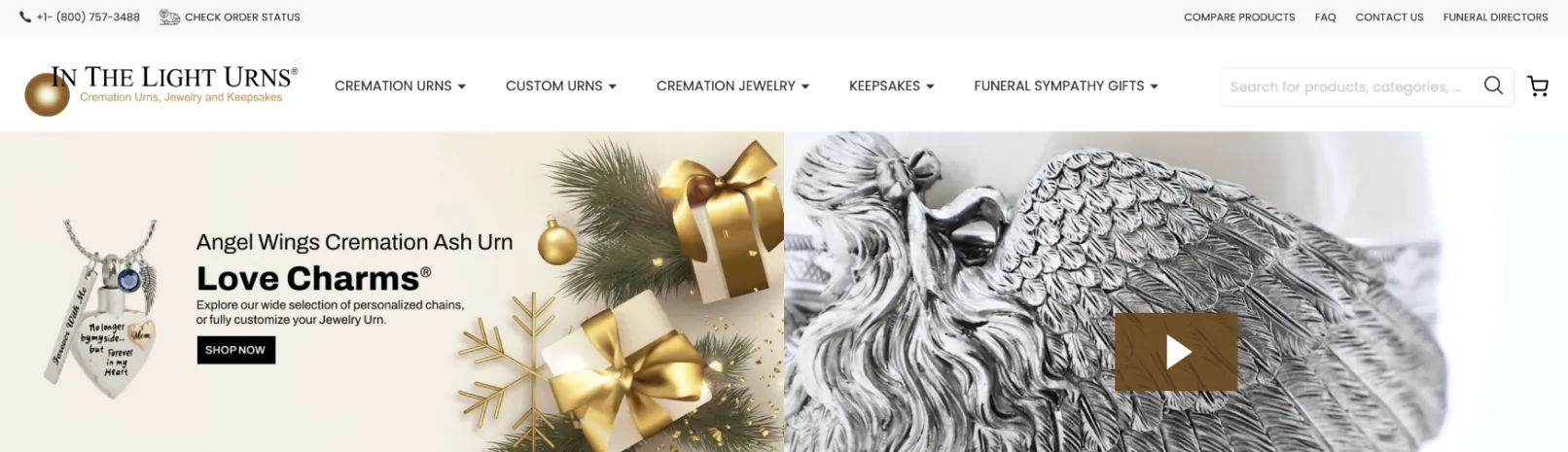
In The Light Urns Inc. is constantly in the pursuit of providing the perfect urn, that last gift, for your loved one. It understands how stressful and agonising it is to lose your loved one. It tries to make the purchase of cremation urns, keepsakes and jewellery as easy as possible. It ensures that a heartwarming, fitting and perfect last gift is offered to the person who was very dear to you. It is this love and warmth that they offer to people in times of distress that has made them the largest online urn company in America.
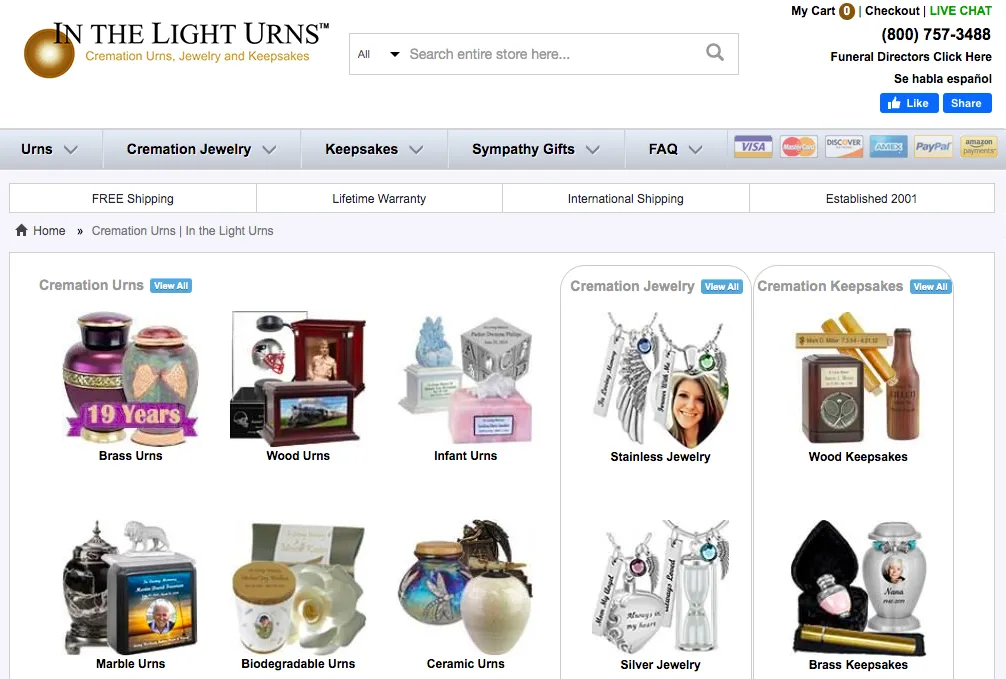
Offering customised urns along with expert engraving, packaging and tracking, In The Light Urns create special memorials. To further enhance their offerings, they were pondering over redressal of their old e-commerce platform. It was based on Magento 1.x. It has been running on it for more than a decade. With changing times, the replatforming was a must-do.
In the incipient stages, OpenSense Labs had an intricate task of choosing between Magento 2.x and Drupal Commerce. After having run their e-commerce website on Magento for so many years, the team at In The Light Urns was very much familiar and at ease with the administration UI of Magento. So, taking this into consideration, a hybrid model was finally agreed upon where Magento will be taking care of the backend with its powerful e-commerce capabilities coming in handy and Drupal will be leveraged as the frontend solution because of its high performance and customisable template engine in Twig.
About the project
Migration
Implementation of the project presented strenuous tasks at hand. To begin with, performing content migration was an uphill job. To get this done, a dedicated sprint was carried out for devising a holistic migration strategy. It was also planned to make the migration SEO-friendly. Therefore, the highest-ranked pages were identified and their complete metadata migration was done while also performing alterations wherever necessary as per the current SEO norms. Migration was performed in two phases. The first one involved the migration path from Magento 1.x to Magento 2.x and the second phase involved the migration path from Magento 2.x to Drupal 8.
AMP
For further enhancements of SEO, we developed an AMP version of the site for faster load times and better user experience even with limited internet connectivity.
Integration of Drupal and Magento
For combining both the platforms, Magento module was utilised. Initially, the module only had support for Drupal 6. OpenSense Labs took the ownership of this module and upgraded it to make it suitable for Drupal 8. The module supports complete CRUD functionality with Drupal Commerce and ensures that Drupal Commerce entities like variations and product types are used perfectly and in congruency with Magento. The module also ensures the synchronisation between Drupal and Magento in cases where Magento products are to be synchronised to Drupal, or Magento attributes are to be dynamically synchronised into Drupal CCK fields, or Magento categories are to be synchronised into Drupal taxonomies among others.
Apache Solr for search
Apache Solr was incorporated using the Search API Solr module to have a superfast, enterprise search feature with custom facets. This ensured that users could search and find their desired products from a vast library of over 10,000 products.
Shipping and order mechanism
Drupal Commerce helped develop the cart and checkout mechanisms. These interact with Magento Order APIs on successful order completion. Magento also provided a host of plugins to make the order management and tracking admin-friendly.
Why Drupal was chosen
Multiple factors went in favour of Drupal 8. As a frontend platform, it offered wonderful content authoring features with its intuitive tools. When compared to Magento, processes like content creation, workflow and publishing were much easier in Drupal. Whether it was to add a customised publishing workflow for products and reviews or to control the position of products over the listing pages using entity queues, Drupal remained a top choice because of its exceptional content management offerings.
The site had to be multilingual. So, Drupal’s out-of-the-box language handling abilities made it a stronger option. Four core modules in Drupal 8 made it simpler to create localised digital experiences quickly and efficiently.
Audience segmentation and web personalisation were other factors that proved significant while choosing Drupal. It made it easier to present targeted content to people of specific regions.
The hybrid model of Drupal and Magento provided plenty to reap merits from. It offered:
- highly secure commerce with limited IP-based access to Magento admin system.
- one platform for theming
- more powerful content workflows and content customisation options.
- highly scalable system
- search functionality powered by Apache Solr that indexed 50+ fields for each of the products.
Technical Specifications
Drupal version: