Sector(s)
Team Members
Visit the site
Visit the siteOrganizations Involved
Community contributions
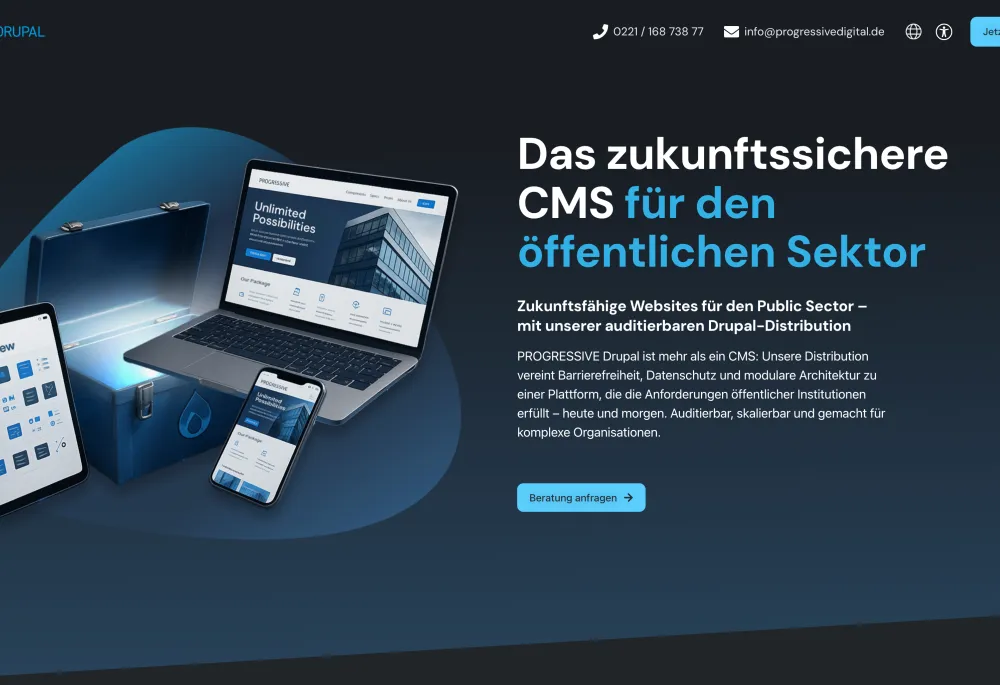
PROGRESSIVE Drupal Distribution: Continuously enhanced for public sector and higher education requirements, providing a pre-configured, accessibility-compliant Drupal platform
Drupal Association: Bronze Supporting Partner, actively investing in the sustainability of the Drupal ecosystem
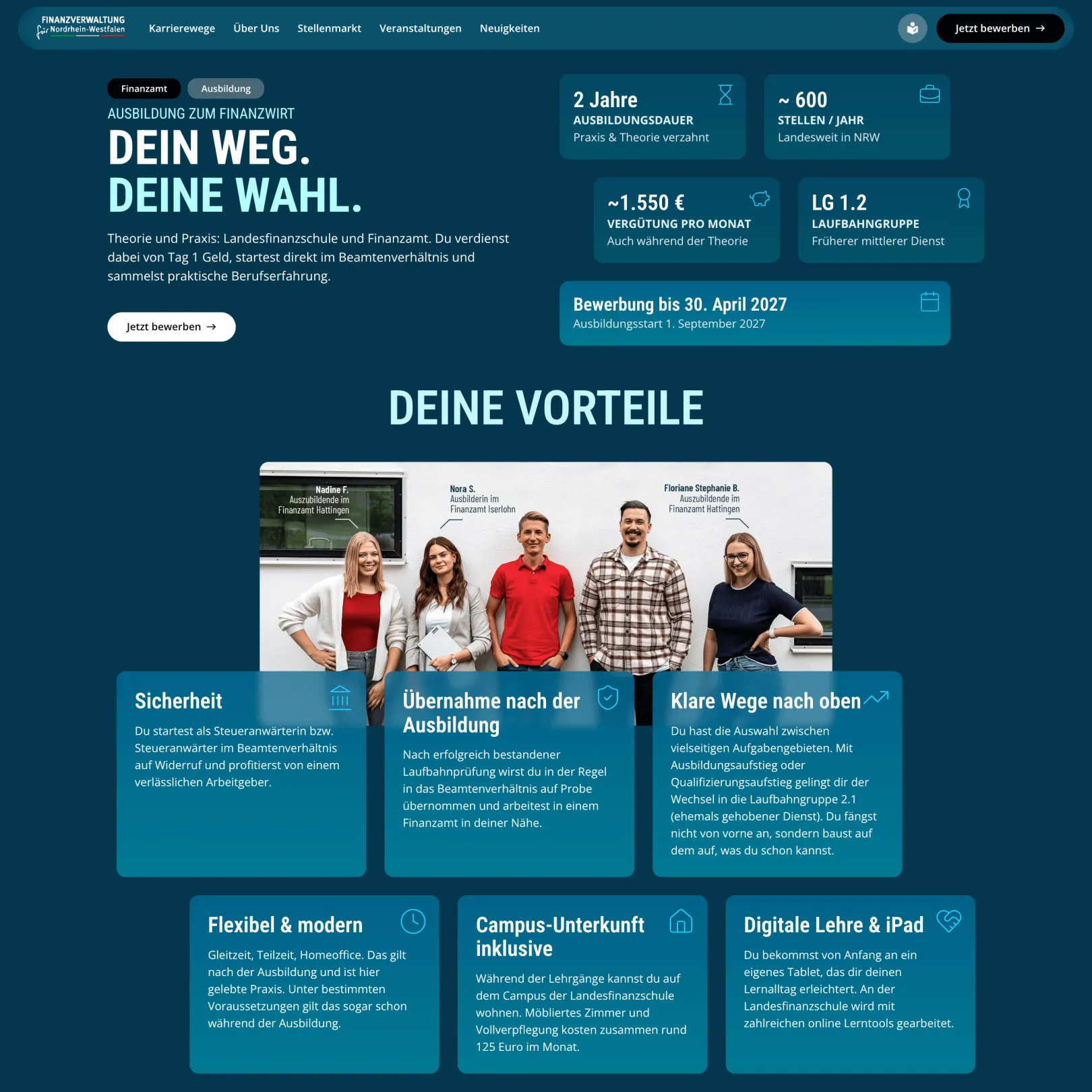
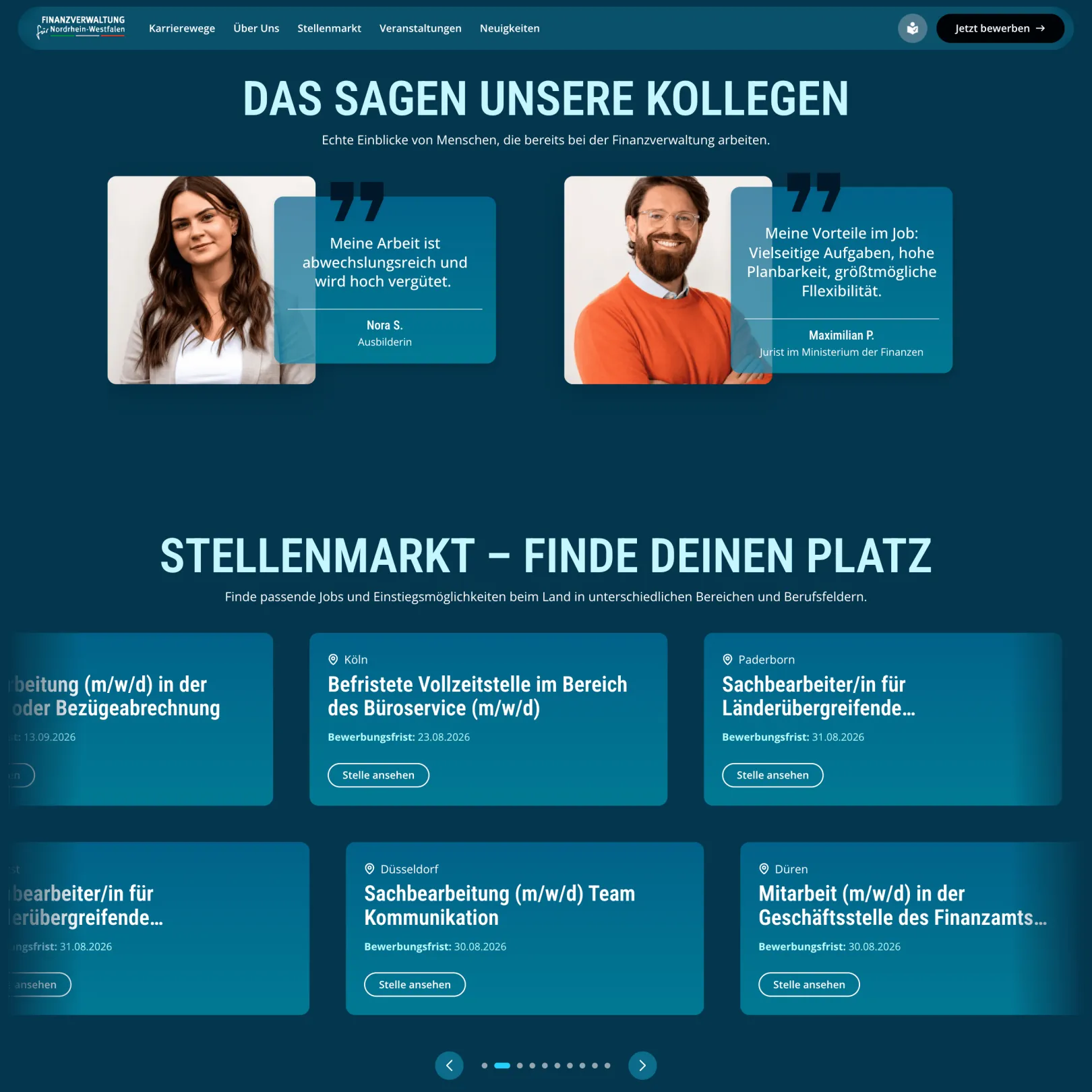
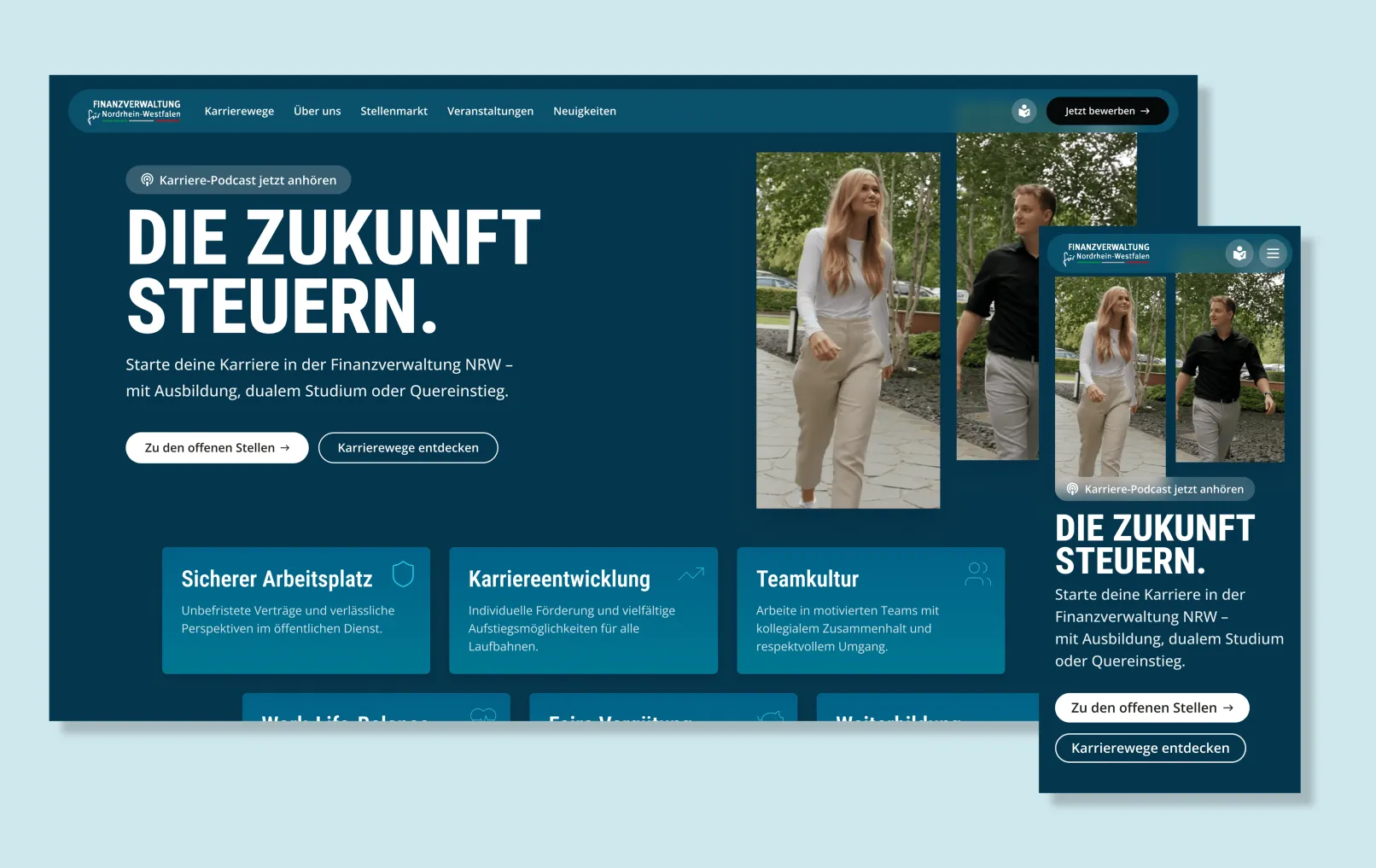
The Finanzverwaltung Nordrhein-Westfalen (NRW Tax Administration) is one of Germany's largest public employers, with around 33,000 staff across seven sub-organizations. PROGRESSIVE digital delivered a complete relaunch of die-zukunft-steuern.nrw, a standalone career platform with its own identity, built to make the full range of career paths visible to a young, digitally native audience.
About the project
Goals
The NRW Tax Administration needed a career platform capable of speaking to six distinct audience segments: school-leavers considering a dual vocational program, students pursuing a dual degree, university graduates entering senior public service, career changers from the private sector, experienced managers, and people with disabilities. At the same time, the platform had to represent seven distinct sub-organizations, each with their own career paths, entry conditions, and workforce profiles. The goal was to position the authority as a modern, attractive employer while staying truthful about who they are.
Challenges
The existing platform was orderly and correct, but it didn't make the breadth of career options visible. A government tax authority does not automatically appeal to young job seekers, and a clean, restrained design with a lot of white space does little to change that perception. The content itself was also due for a rethink: videos and tutorials that no longer reflected the actual career paths had accumulated over time and needed to go.
The structural challenge ran deeper. Over ten distinct job profiles, five training and degree pathways, two lateral entry routes, and separate landing areas for six audience groups all had to fit into a single navigable system without losing coherence or creating dead ends for any visitor.
Approach
The project started with a joint kickoff workshop to assess what existed, what needed to change, and what could stay. Existing content was analyzed and transferred into fitting modules rather than replaced from scratch. The design process ran through several rounds of exploration, and early concepts received qualified feedback: not bad, but not distinct enough. The breakthrough came with three dark-mode concepts that broke fully with the public sector aesthetic.
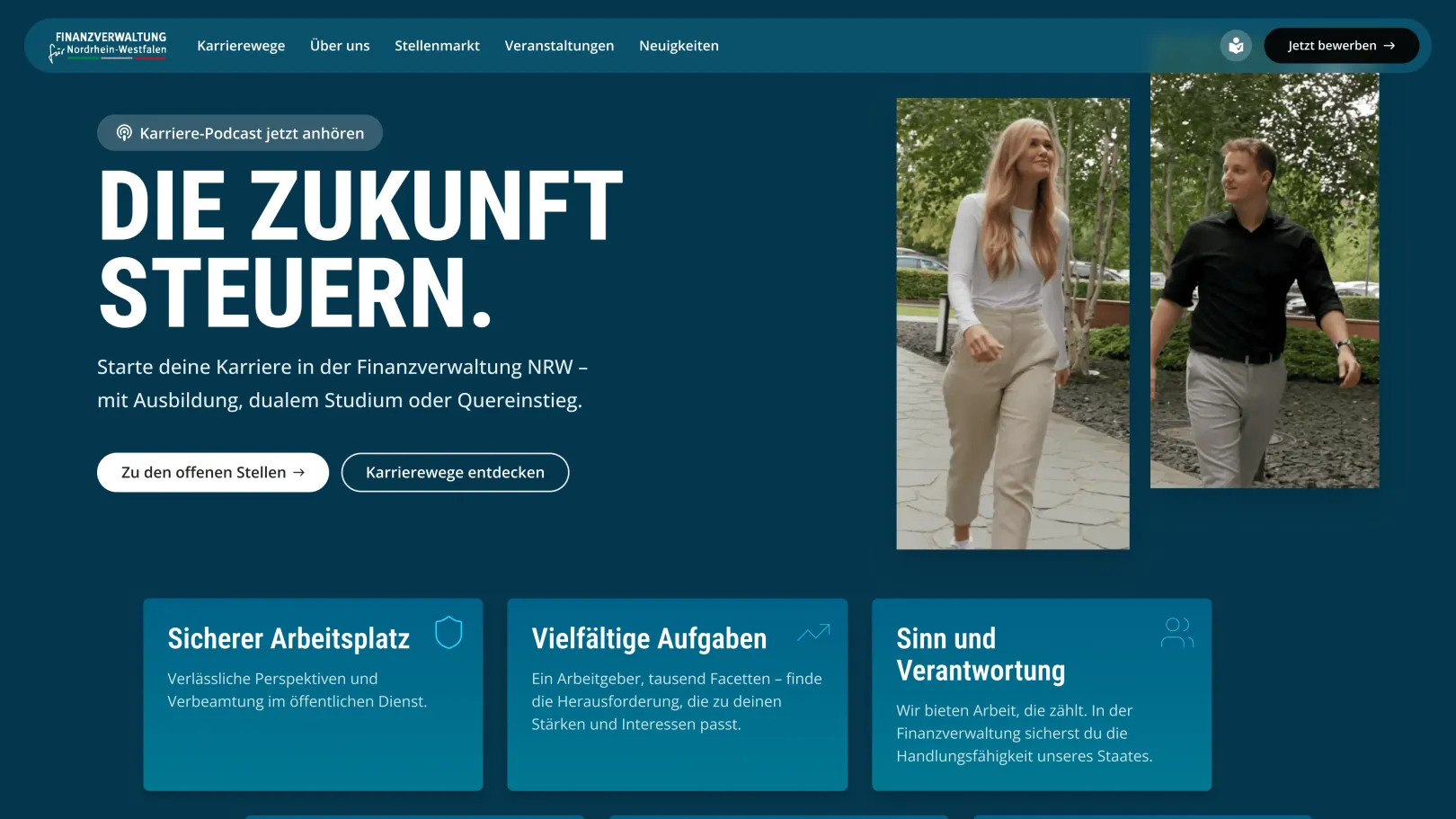
Dark teal and navy became the primary palette. Beyond the color shift, the layout itself became more dynamic through asymmetric arrangements of elements, giving the platform a visual energy the previous version lacked.
Drupal's paragraph-based component system forms the technical foundation. More than 15 reusable components, including hero sections with standardized fact cards, accordion FAQs, call-to-action cards, and testimonial sections, can be assembled per page type without custom development for each sub-organization. The relaunch also introduced several new content areas that had no equivalent on the old site: a job market section that filters open positions by sub-organization and entry type, a news page, a dedicated section for the authority's career podcast, and a social wall that allows any social media channel to be embedded and managed editorially.
Throughout the project, PROGRESSIVE digital served as a continuous point of contact, supporting the client through multiple design iterations, the content transfer process, and final refinements until the result met expectations.
Outcome
The project concluded with an editorial handover workshop, and the client's communications team now manages and updates the platform independently in Drupal.
Key results:
- One Drupal platform for seven sub-organizations and over ten job profiles
- Six distinct audience segments addressed with targeted content pathways
- More than 15 reusable components, manageable without developer assistance
- New content areas: news, podcast section, and a flexible social wall
Why Drupal was chosen
The platform needed to serve structurally very different content for seven sub-organizations and six audience segments without requiring custom development for each section. Drupal's paragraph-based component system made it possible to build a reusable library of more than 15 components that editors can combine freely, and its flexible content type architecture allowed the team to map distinct page structures for job profiles, training pathways, and lateral entry routes into a single coherent system. Drupal also gave the client's editorial team a manageable back end that they could take over independently after the handover workshop, without ongoing development support.
Technical Specifications
Drupal version:
Key modules/theme/distribution used:
Accessibility compliance The accessibility_statement module generates the legally required accessibility statement from structured configuration fields rather than a free-text node, enforcing completeness of all mandatory sections and keeping the statement consistent across sites. Editoria11y integrates accessibility checking directly into the editorial interface, so issues are caught at the point of content creation rather than after publication. The unicode_soft_hyphens module handles controlled hyphenation across the platform, which affects general readability and becomes particularly relevant for content that needs to meet Leichte Sprache standards.
Privacy-compliant analytics and cookie consent Cookie consent is managed through a fork of cookiesjsr combined with cookies and cookies_addons, covering the full consent lifecycle including a Matomo-specific delay patch that prevents tracking from firing before the visitor has given explicit consent. Matomo keeps all usage data within the authority's own infrastructure. This combination meets German data protection requirements without relying on third-party consent services.