Sector(s)
Project Team
Andy Thornton- Sr. Drupal Consultant (Performance & Security)
Chris Hales- DevOps Manager, Lead Architect
David Bassendine- Sr. Drupal Consultant
Don VanDemark- Sr. Project Manager
James Rutherford- Lead Drupal Architect
Jay Callicott- Product Manager, Lead Architect
Josh Estep- Sr. Drupal Developer, Themer
Robyn Green- Sr. Drupal Developer, Themer
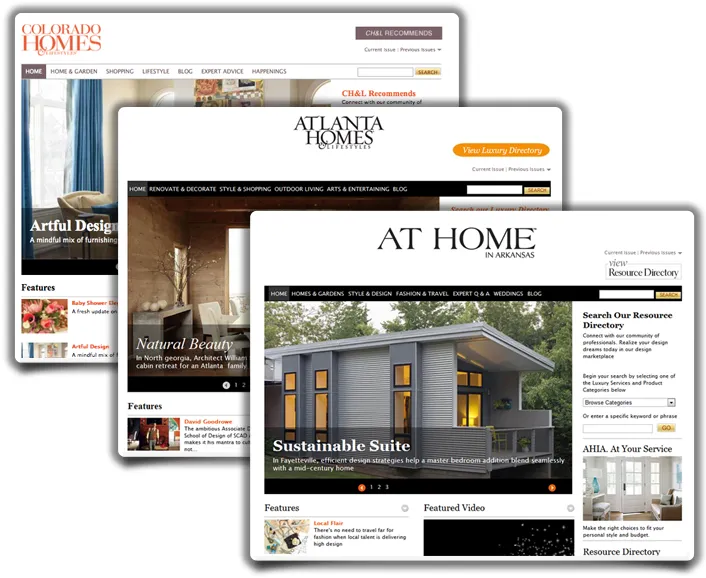
http://www.athomearkansas.com/
http://www.atlantahomesmag.com/
http://www.stlouishomesmag.com/
http://www.coloradohomesmag.com/
http://www.mountainliving.com/
http://www.kchandg.com/
http://www.nehomemag.com/
Industry-leader, Network Communications, Inc. turned to Drupal as a solution for implementing a highly customized content management system to publish home design content and ads to regional markets around the United States.
As the need to allow each market to alter their site and reach their desired target audience became apparent, NCI desired a company with a reputation for high-caliber Drupal support services delivered in a timely fashion—they turned to Mediacurrent
While the sites were designed well, behind the scenes, the original creators had implemented highly-customized functions that needed to be brought into an approach that better matched Drupal “best practices.”
About the project
About NCI
NCI is the largest publisher in the United States of printed and online magazines for the real estate market. Almost everyone in the U.S. has seen their real estate magazines in one of the 300,000 distribution points you can find them. The websites serve as an additional avenue to reach their markets. They have 22 distinct brands that are tailored to specific target audiences within each market.
Challenges & Solutions
When sites such as www.atlantahomesmag.com and www.mountainliving.com grew in popularity, NCI realized the custom Drupal platform was not meeting their advertisers’ demands for customization and fast performance during peak traffic periods.
Final Thoughts
NCI is a common scenario, and similar to other organizations that have engaged us in support services. Their web sites were initially created by a web agency whose speciality was not strictly Drupal. The agency's lack of deep Drupal experience resulted in a cobbled together Drupal platform that was inflexible, slow, and laborious to maintain.
As an extension of NCI’s team, Mediacurrent was able to rapidly develop new features like custom ad campaigns and targeted search, while continually improving the backend experience for NCI's content editors. Mediacurrent utilized its Drupal expertise to analyze and improve on NCI's technically advanced Domain Access enabled platform, while maintaining a high level of performance across the sites.
NCI has since extended the support agreement and partnership with Mediacurrent. We are now in the planning phases for an upgrade to Drupal 7.
Why Drupal was chosen
Industry-leader, Network Communications, Inc. turned to Drupal as a solution for implementing a highly customized content management system to publish home design content and ads to regional markets around the United States.
Technical Specifications
Key modules/theme/distribution used:
NCI’s main feature was a custom rotator for each of their sites that allowed them to organize advertiser displays in three very specific ways, all while streamlining the maintenance of the site. Once again, we were able to utilize a number of Drupal’s contributory modules (Views, Draggable Views, CCK) and a custom-built module to give site editors their requested user-interface.
While working on their main request, we also made a list of their modules that did not meet Drupal standards. A LAMP stack analysis was also performed to help NCI deal with load issues. Mediacurrent was able to identify configuration changes to help improve performance during peak traffic times.
Theming & Design
A major constraint on NCI's ability to introduce new features across the CMS was due to incorrect theme implementation. Many lines of business logic code needed to be moved from the theme (presentation) layer and into module configuration. We corrected issues such as, consolidating code and styling duplication into single sources, and removing display logic from the theme layer. Where possible, we utilized the Context contributed module to improve UI and allow easier configuration of complex layouts. When these steps were completed, new feature implementation was much more seamless.