Sector(s)
Project Team
Kevin Basarab - Sr. Drupal Developer
Jay Callicott - Product Manager, Lead Architect
Kendall Totten - Drupal Designer and Theming Specialist
Jeff Diecks, V.P. Professional Services
About Mediacurrent
Mediacurrent helps organizations architect custom websites by leveraging our proven processes and deep expertise in Drupal. We are home to an elite team of Drupal experts, who have a proven track record of building amazing websites. We strongly believe in open-source principles, collaboration, and sharing knowledge to strengthen the Drupal community. For more information regarding Mediacurrent's services and portfolio please visit http://www.mediacurrent.com.
Mediacurrent would like to thank Oakland University for volunteering to write the Alaska Dispatch case study.
About Applied Technology in Business (ATiB)
Applied Technology in Business (ATiB) is a program at Oakland University in Rochester, Michigan. It is a program for undergraduate business students who learn about Drupal and IT. Brittany Johnson and Melissa Wesolowski, two ATiB members, researched and wrote this case study. For more information, please visit: http://www.oakland.edu/atib
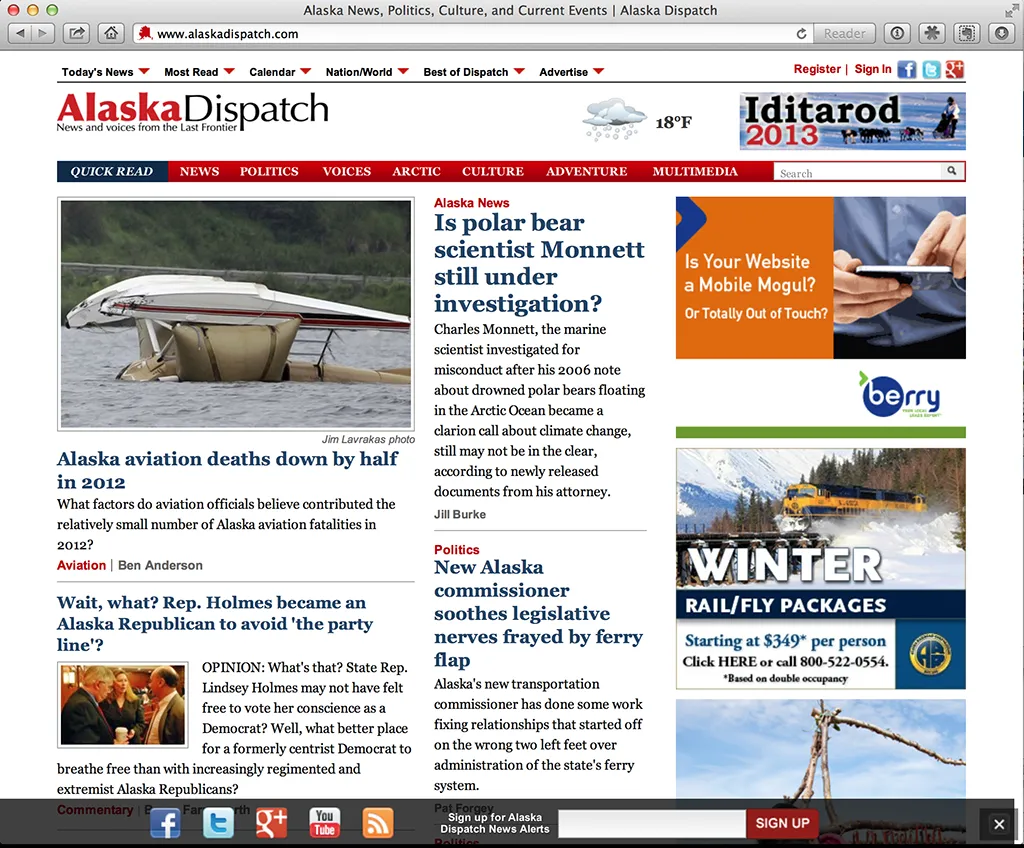
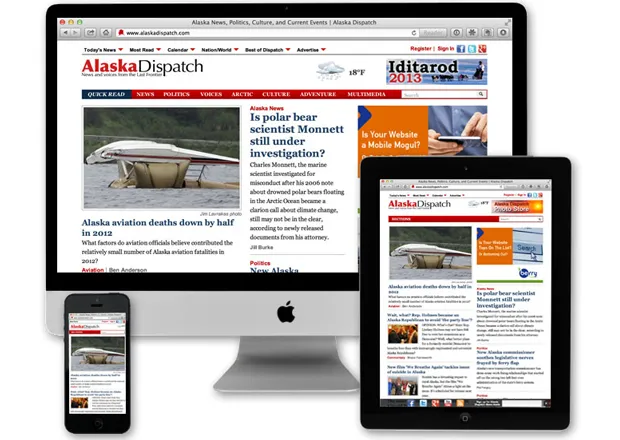
Needing an upgrade from Drupal 6 to Drupal 7, Alaska Dispatch took an opportunity to relaunch alaskadispatch.com in January 2013 with a new responsive web design. Alaska’s online-only news site features solutions for incorporating advertising into a responsive theme—a primary challenge faced by the publishing industry as it adapts to the variety of devices and screen sizes available to readers.
The owners of Alaska Dispatch believe they are paving the way nationally for what will be the future of online journalism—locally produced stories presented on for-profit websites. From political corruption to climate change to rural Alaska to the rise of Sarah Palin, Alaska media has struggled to cover stories of importance not only to Alaskans but to the rest of the nation. Alaska Dispatch was founded by Tony Hopfinger in 2008. In mid-2009, Alice Rogoff, a longtime supporter of journalism and a former chief financial officer of U.S. News and World Report, became the majority owner of Alaska Dispatch Publishing LLC, and the site expanded to employ writers, editors and a full-time sales team.
Combing the design and development updates and the implementation of responsive theming, Alaska Dispatch has seen an increase in visitor traffic, social media engagement, and a 30% increase in ad impressions.
Today, Alaska Dispatch is the second-most visited news site in Alaska. Much of its success has come from embracing technology and social networking. “We don’t have a broadcast signal or newspaper rack to distribute and market our product,” explains Tony Hopfinger. “To get our name out there and build readership, we depend on Mediacurrent to help us push the limits of Web development, which in turns helps build our audience and strengthen the reading experience."
We began mocking the D7 site in April 2012, with Alaska Dispatch art director Aaron Jansen coming up with the designs for the various thresholds. The goal was to place a new emphasis on mobile and tablet devices, and responsive theming was the solution.
“We have been very impressed with Mediacurrent’s forward-thinking approach in our industry,” says Alice Rogoff. “Mediacurrent’s team recommended responsive theming to us, and it was the perfect solution for ensuring Alaska Dispatch is accessible on all devices.”
About the project
Goals
- Upgrade to Drupal 7 to take advantage of new features
- Implement a responsive design so that the site can be easily viewed on mobile devices
- Remove article pagination to increase user-friendliness without sacrificing advertising impressions
- Showcase new high-quality photography being produced by newly hired photo editor
- Provide a better foundation from which new features and ideas can be added to the site in the future
Challenges and Solutions
One challenge common to upgrade and redesign projects is preparing the new site in parallel with ongoing content publishing on the current site. Module and core upgrades, content migration and the build of the new theme were scripted and tested in a parallel environment to allow for review and testing of the new site. The news cycle never stops, so the Mediacurrent team needed to minimize the window of time needed to promote the upgraded site and content into production. Mediacurrent used the Features module to store configuration as code, and drush scripts to automate the migration of the database from Drupal 6 to 7. The migration team would periodically take a snapshot of production, run the migration scripts and test to make sure that content and site structure upgraded successfully. With this iterative process, Mediacurrent was able to fix bugs and lower the risk of problems when the upgraded site went live.
Another challenge came with properly displaying advertisements on the site. Since Alaska Dispatch is an ad-based, for-profit enterprise, ads are a major part in the site layout. In order for the site to be visually balanced on all devices, ad spots had to be rearranged while keeping ad impressions accurate.
Why Drupal was chosen
Alaska Dispatch originally launched on Joomla, but its rapid growth created a need for the scale and flexibility that Drupal and Acquia's hosting could provide. A redesigned site launched on Drupal 6 in 2011 using OpenPublish. The upgrade to Drupal 7 allowed Alaska Dispatch the opportunity to stay current with Drupal security updates and to leverage features of Drupal 7 such as a responsive theme and improved feeds processing.
Technical Specifications
Key modules/theme/distribution used:
Advertising and the Ad Module
The site redesign provided opportunity to refine the placement of advertising on the site. Requirements included removing pagination from articles without reducing ad impressions, incorporating advertisements into the new photo gallery features, and adapting ad sizes presented on different screen sizes in the responsive theme.
The article pagination change was implemented to make the site more user-friendly. Previously, articles were split up on multiple pages in an attempt for ads to get the most exposure. But for users, sitting through multiple page-loads to read one article can be a negative experience, especially on mobile devices where connection speeds are slower. Now, full articles can be viewed on just one page, with minimal server calls. To ensure that advertisements were getting the maximum exposure in the full page articles, Mediacurrent developed a calculation for the placement of ads based on an article’s length. The amount of paragraphs in an article and the number of characters in each paragraph were factored into the calculation. With this information, it was then determined how often an ad would be shown within the content of an article, and how many ads would be shown in the rail on the right.
Mediacurrent also built a custom module to help solve challenges of advertising within a responsive theme. The module defines four breakpoints: mobile, tablet, desktop, and wide desktop. For example, media queries detect that the screen width has changed from mobile to tablet, so javascript loads ads in a different location so that the site alternates between content and ads and stays balanced. When using this module, the user can set up the positioning of the ads on the site and assign ad server variables to each position at each breakpoint. The user has control to tag keyword variables to the ads. The use of iFrames is a major part of this module because when ads load, they are loaded separately from the page itself. Mediacurrent is working towards contributing a version of this module to the Drupal community. The contribution would include a baseline module that would provide the hooks for sub modules that would allow configuration of ad positions.
Responsive Theme
Implementing a responsive theme was one of the main benefits of upgrading to Drupal 7. Before the upgrade, the Alaska Dispatch website had Javascript written into the code which redirected a mobile user to a different site to view the news. The previous mobile website did not include the full content that was on the actual website, which is not ideal. Website maintainers should never assume to know better than their users what content the users want. Using device-detection redirection is never 100% reliable. But with a Drupal site that is truly adaptive and a responsive theme like Omega, users viewing the site on their phone or tablet have access to the full site contents in an easy-to-view format. Since Alaska Dispatch connects with their readers solely through the Internet, it is critical that they can reach their audience regardless of the device the reader is using.
Site Workflows
Workbench Moderation is a common Drupal module used for newspaper sites to maintain workflow. However, Alaska Dispatch already had workflows in place from the previous site. Mediacurrent refined these site workflows by adding rules and content overview screens for administrators and editors. By doing this, the workflow that was achieved was specific to Alaska Dispatch’s own work process and a module like Workbench Moderation was not needed. This workflow process works in a straightforward and effective way. When a reporter submits an article, it remains unpublished and an email gets sent out to the editors. This is where a custom content overview screen is used so the editor can view all the articles waiting in queue to be reviewed. Administration screens were made easier to use for tasks such as creating new articles. For this creation process, the contributed module Fieldgroup was used to create horizontal tabs on top of the article creation screen that are meant to help guide creators and editors along each step. The first tab is for the article content, including title, body, teaser, etc. The next tab is to categorize the article and choose key words, using the Term Reference Tree module for taxonomy purposes. By using available modules and customizing the content overview screens, Alaska Dispatch received a tailored process that corrals the node/add form into a better user experience.
Social Media Integration
Social media was a major focus when making changes on the site. Using LoginRadius, users have the capability of signing into the Alaska Dispatch site through various social media sites, such as Facebook, Twitter, and Google+. A major advantage of using social media integration is that articles from the site will get more exposure than they normally would. Alaska Dispatch moved away from standard Drupal comments in favor of Facebook comments. News organizations that use Facebook comments see a higher quality of discussion and a significant increase in referral traffic. It is also easy for users to share stories and content from Alaska Dispatch. With one click of the share button, users can tweet, post, or share an article easily to a large audience.
Calendar
The Drupal 6 version of the site had a calendar that listed local events. The site calendar experienced some changes during the upgrade to Drupal 7 that allowed it be more interactive. Users can now add events that are happening in their town and share them with everyone who views the site. When a user adds their event, a node is created. The website’s content editors receive a notification of this node, and then they can review and approve the added event. This workflow prevents anyone from adding any unauthorized event they want, while still letting the users share their event with the community. Any logged-in user can submit an event that will display the venue, time, and location where it is taking place, as well as upload an image. Geolocation modules are used to map where an event is taking place.
Slideshows
Showcasing photography is a key addition to the Drupal 7 site. Views Slideshow plus Client-Side Adaptive Image modules were used as the baseline for providing a good user experience with the slideshows. Challenges faced included making the slideshow responsive, adding show/hide thumbnails capability, adding finger swipe navigation and changing the background color of the page. Custom javascript and CSS along with some custom module additions overcame these challenges.
Summary
The upgrade of the Alaska Dispatch site to Drupal 7 provided up-to-date security, better functionality and easier maintenance. Mediacurrent incorporated a custom modules to increase ad impressions and streamline editor workflows, while also improving the end-user experience on mobile devices by switching to a responsive theme. These changes, along with the changes to incorporation of social media and enhance the site, helped Alaska Dispatch to provide the greatest user experience for both site administrators and site visitors.