Sector(s)
Team Members
Wolters Kluwer is a market leading global information services company with 19,000 employees whose information, software, and services help legal, tax, finance, and healthcare professionals in over 150 countries. They combine information and technology to help their customers’ quality and effectiveness. For example, they support 210,000 tax and accountancy firms worldwide; that’s 40 million tax returns!
Wolters Kluwer UK had a number of proprietary platforms that supported their information product portfolio. They wanted to move to a model which would allow deep self-service for customers across their suite of information products, in real time. They also wanted to unify their customer products, where sensible, into one technology platform. Drupal enters from stage left…
Wolters Kluwer UK were interested in entitlement, authentication, customer self-management, content consumption and to refresh all their products for the multi-device, multi-platform world. These changes would support their goal of creating new products for their target markets from their vast content base.
About the project
We gained the trust and understanding of the Wolters Kluwer executive team by meeting with product and IT stakeholders to map out their business operations, current processes and future requirements. In a series of workshops, we mapped out the flow of data, the flow of customer transactions and experiences. We learnt about the internal systems, which were considered master of record for each type of data. These maps were used to support the move to digital by ensuring the new build integrated directly with the right systems and supported the customers, wherever they are.
The first step was to remove legacy software, which was becoming expensive to maintain and hindered their product growth, and build new platforms with modern software. As Wolters Kluwer wanted to reinvigorate their technology and create a more efficient content management system, modernising their software had to come first.
We migrated data from SAP, Broadvision, NXT, Documentum, and even legacy content stores based in Revision Control System (RCS). Wolters Kluwer now has the option to build their own content in a ‘shopping cart’ approach. Staff can select a number of categories, or libraries of information and tools, to sell content to their target market. Drupal enables this content management using their regular concepts.
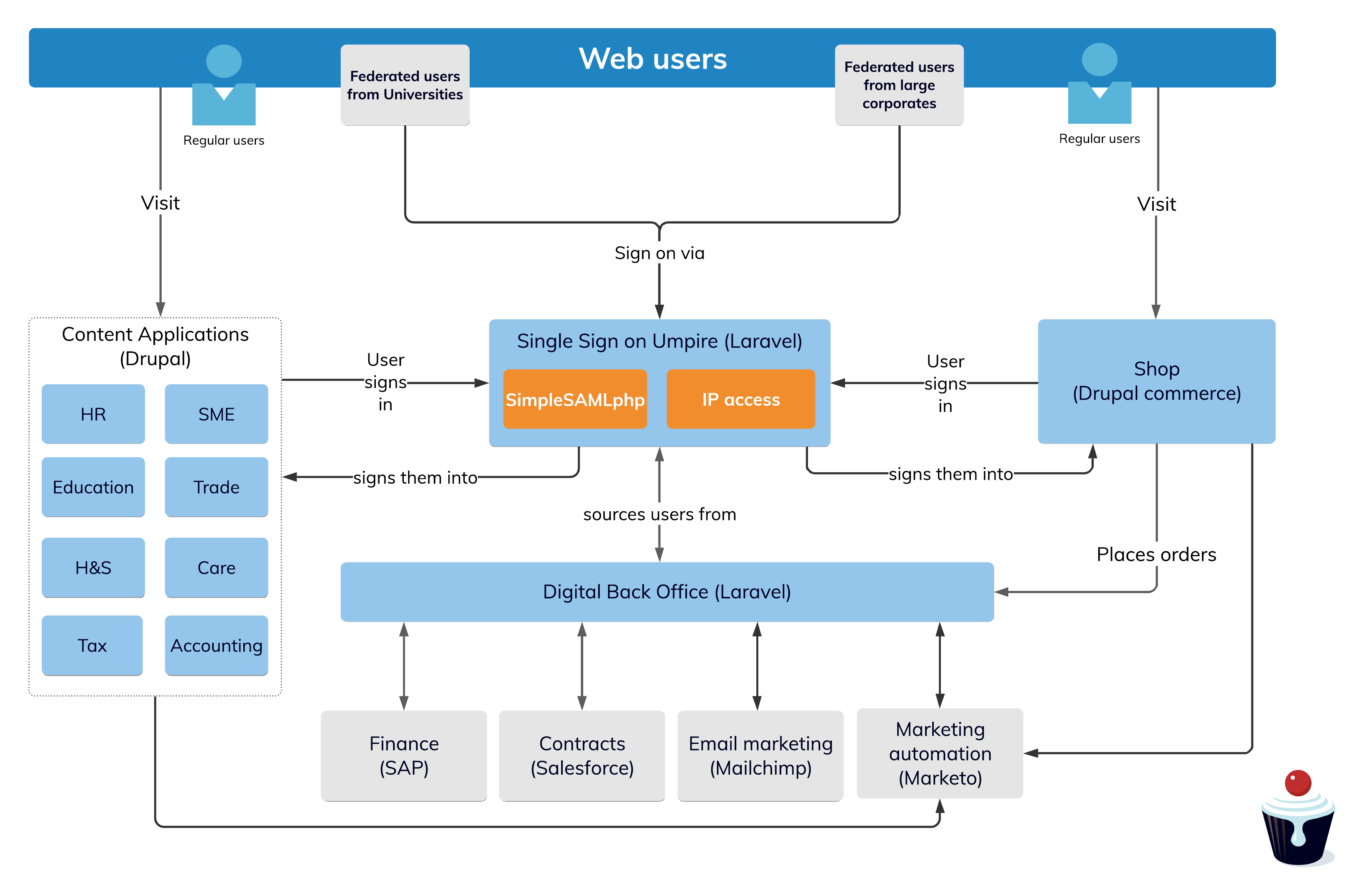
We built the content applications in Drupal. We built the customer portal and single sign on system in Laravel. The customer portal manages all entitlement and authorisation aspects and allows the flow of users from universities, large corporates and other single sign on sources whilst also providing single sign-on via SAML to our content applications. Drupal powers all of the content platforms and all sign-ins took place as a result of SAML sign in requests “assertions” from the customer portal. The customer portal is called “Digital Back Office” in the diagram above.
Together, this enabled customers to access their own information, subscriptions and products, as well as purchasing new products. We built the first phase of the portal at the same time as the first customer-facing content application, so that Wolters Kluwer could iterate on each content application, delivering benefits to customers quicker and more often.
We successfully integrated with an existing Wolters Kluwer single sign-on system, called Ping Identity, before then replacing Ping entirely with open source software built upon Laravel and SimpleSAMLphp to lower cost and reduce enterprise software fees.
The content applications contain vast amounts of data, around 19 million documents. This huge database needed to be separated and simplified for an easier user experience. We wrote a large-scale migration of content from their various forms, such as Broad Vision, NXT, PDF, HTML and even RCS into Drupal.
We also migrated the customers records from the previous customer databases spread around the legacy product set. We additionally built an extendable IP access solution. This allowed people to get access to content on a recognised and permitted IP address, but continue to use it wherever they were, as long as they signed in back in at their office location from time to time. This enabled remote working for their customer workforce that travels to their customer locations, people like accounting auditors.
After the successful content migration, we focused next on their content management principles and processes, with the goal of developing a combined digital and print world in which Wolters Kluwer does business.
Today, students, finance pros, HR pros and a whole collection of other professionals alike use the 19-million-document content applications that we built. They are sold to international corporations, sole traders and everyone in-between. Even HM Revenue & Customs (HMRC), the UK Tax agency, purchased it!
To support their essential guidance offering, we built additional timesaving features. Users can fill in web forms to produce legal documentation and contracts. It has folder technologies, which means clients can store their clients information and cases in the platform, all using regular Drupal entities and modules.
While Wolters Kluwer was already selling dozens of products, they needed to simplify and merge their content into easier to understand packages. We curated the content into taxonomies so that Wolters Kluwer could select and build selections into sellable packages at will.
We put Wolters Kluwer into the Google Flexible Sampling Scheme to get more content into Google search engines and increase their search footprint. This increased the subscriber rate. We partnered with Algolia search to provide real time faceted search results. Having a very fast search over many millions of documents is a real differentiator against competitor products, which often offer slow awkward search solutions.
We built a number of ‘finder’ tools, including: ‘Statute finder’, ‘HMRC Manuals finder’, ‘Legal case finder’ and ‘Legal standards finder’. These allow users to search content within the 19 million documents of the site to find legislative information. Drupal uses content metadata to power the lookup, so the site can deliver the pages customers need, quickly.
Outside of legislation we built contract creation tools, chemical database research apps, integrating with eCPD applications and many other tools.
Using Laravel with SimpleSAMLphp, we built an identity and entitlement (or licence) framework to handle subscriber access in a digital back-office. By integrating with Drupal, finance and contract systems it meant customers needed only one account to access all their product subscriptions. This system also enabled newsletters to flow to Mailchimp from multiple Drupal content streams. It powered user reporting and kept private user data away from Drupal, where Umpire, the single sign-on system we built, federated customers for other organisations.
While this is a case study on Drupal.org, the entire solution was not built solely in Drupal, but it was all built together. Drupal embraces software built outside of its ecosystem so the fact that we could link SimpleSAMLphp with Drupal and Laravel to create a seamless experience was amazing. The digital back-office and single sign-on system (Umpire) contained no content and were focused on contracts, users and reporting data.
Why Drupal was chosen
Wolters Kluwer UK wanted to reinvigorate their technology and repackage the vast amount of content they held for their information business.
Full Fat Things built software with Drupal that not only migrated all of their content into one location, it also enabled us to build additional features quickly. This allowed Wolters Kluwer to sell their content in a variety of ways to support their target market and growing needs.
Drupal enabled us to migrate millions of documents efficiently, into dedicated sites for each industry. This included over 19 million documents across tax, accounting, HR, small business, health care, police and many other sectors.
Using Drupal resulted in countless content management efficiencies for Wolters Kluwer, allowing their information products to get to market faster, and at scale.

Technical Specifications
Drupal version: