Sector(s)
Team Members
Project Team
Organizations involved
Vivalto Santé: Customer, Infrastructure and domain teams.
Dropteam: Drupal expertise, architecture, and consulting.
Visit the site
Visit the siteOrganizations Involved
Community contributions
This project is at the heart of the UI Suite initiative, co-funded and maintained by Dropteam . Contributions include:
- Development and maintenance of modules allowing standardized integration of Design Systems in Drupal (UI Patterns 2.x, UI Styles, etc.) .
- Promotion of the "Design Systems with Drupal" approach through numerous conferences (DrupalCon Europe, Drupal Dev Days) and articles .
- The Vivalto Santé project serves as a major proof of concept ("Use case") validating Drupal's ability to manage complex Design Systems industrially .
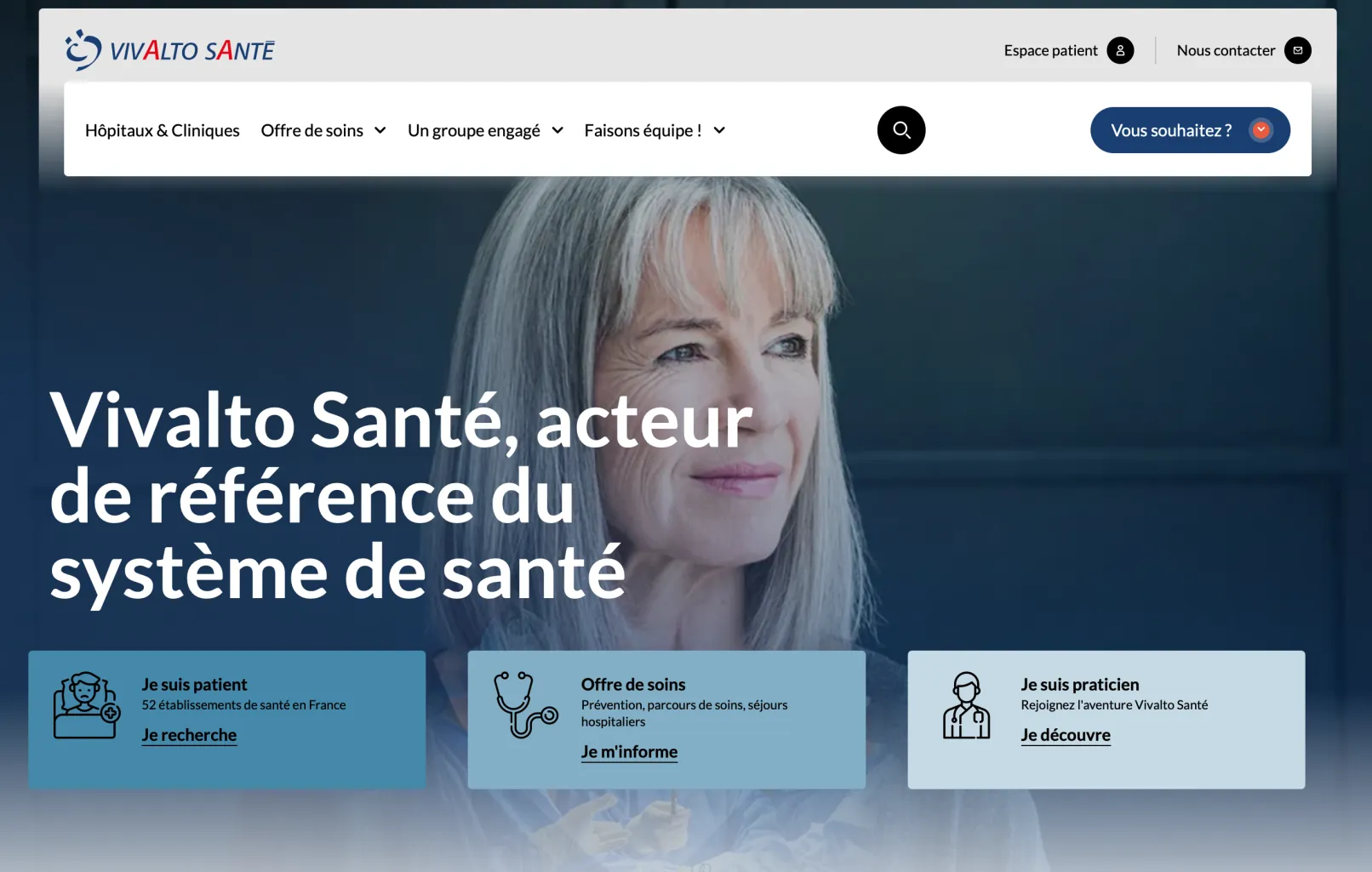
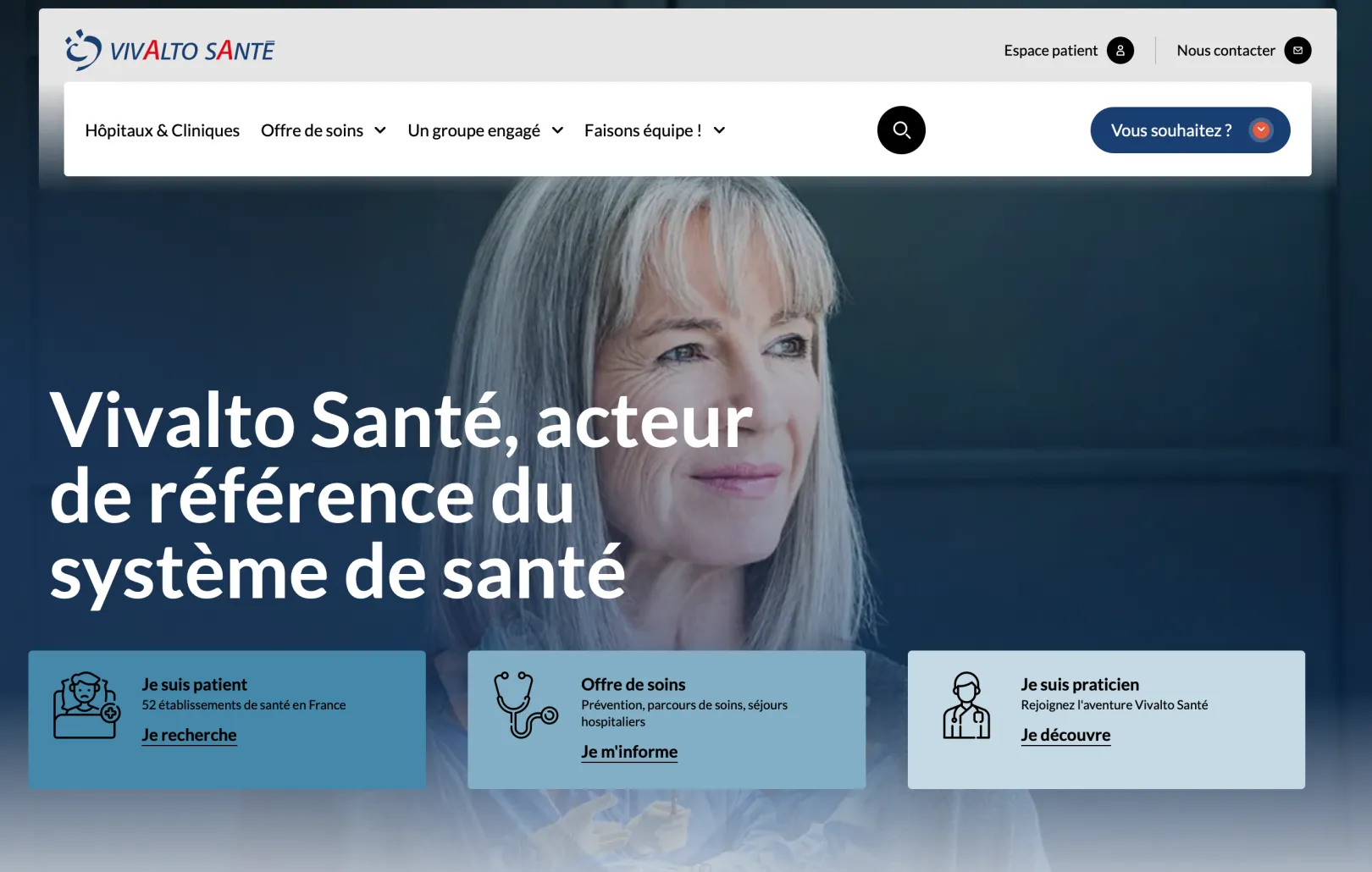
Vivalto Santé, a European leader in private hospitalization, faced a fragmented, heterogeneous digital ecosystem that was costly to maintain . The group wanted to rationalize its brand image while allowing local autonomy for facilities . The project involved creating a multi-site foundation capable of managing the group's websites, hospitals, territories, specialties, and practitioners .
About the project
Goals & Requirements The main objective was to support the group's growth by resolving issues of redundant maintenance, site heterogeneity, and lack of rationalization . Key requirements included:
- Rationalization: Unify brand image and UX .
- Time-to-Market: Accelerate the deployment of new sites and features .
- Interoperability: Fluid connection with business tools (Doctolib, hospital IS) .
- Accessibility: RGAA compliance .
Project Outcome & Business Solutions Dropteam deployed a "Site Factory" (Web Component Factory) based on a centralized Design System . The architecture allows each site in the ecosystem (facilities, territories, etc.) to benefit from its own configurations while sharing a common data model and media .
Results Achieved Technical and financial results are significant:
- Cost Reduction: Migration and maintenance costs divided by two (-30% to -50%) .
- Productivity: +40% productivity gain for teams and -50% production time .
- Performance: Load time divided by 3 .
- Security: Zero front-end vulnerabilities thanks to static architecture .
Why Drupal was chosen
Drupal was chosen for its native ability to handle complex data architectures and business rules ("Greatest low-code CMS for data") . Specific reasons include:
- Multi-site Management: The ability to industrialize management via Domain Access to pool content and users .
- Design System First: Native component integration via the UI Suite initiative, allowing a shift from "Legacy theming" to component-based theming (SDC) .
- Security & Performance: The ability to decouple the CMS via Tome to generate static sites, eliminating PHP/SQL vulnerabilities on the front end and reducing the carbon footprint .
Technical Specifications
Drupal version:
Key modules/theme/distribution used:
- Domain Access: Chosen for content pooling and centralized management of the entire fleet of sites (Group, Facilities, Practitioners) from a single back-office .
- Tome: Selected to transform Drupal into a static site generator. This serves HTML/CSS/JS files via a public CDN, ensuring total security (no exposed database), infinite scalability for traffic spikes, and a reduced carbon footprint .
- UI Suite & SDC: Chosen to implement a "Low-code" theming approach. This allows direct mapping of Design System artifacts (Components, Icons, Styles) to Drupal plugins, ensuring perfect visual consistency and easier maintenance .