Sector(s)
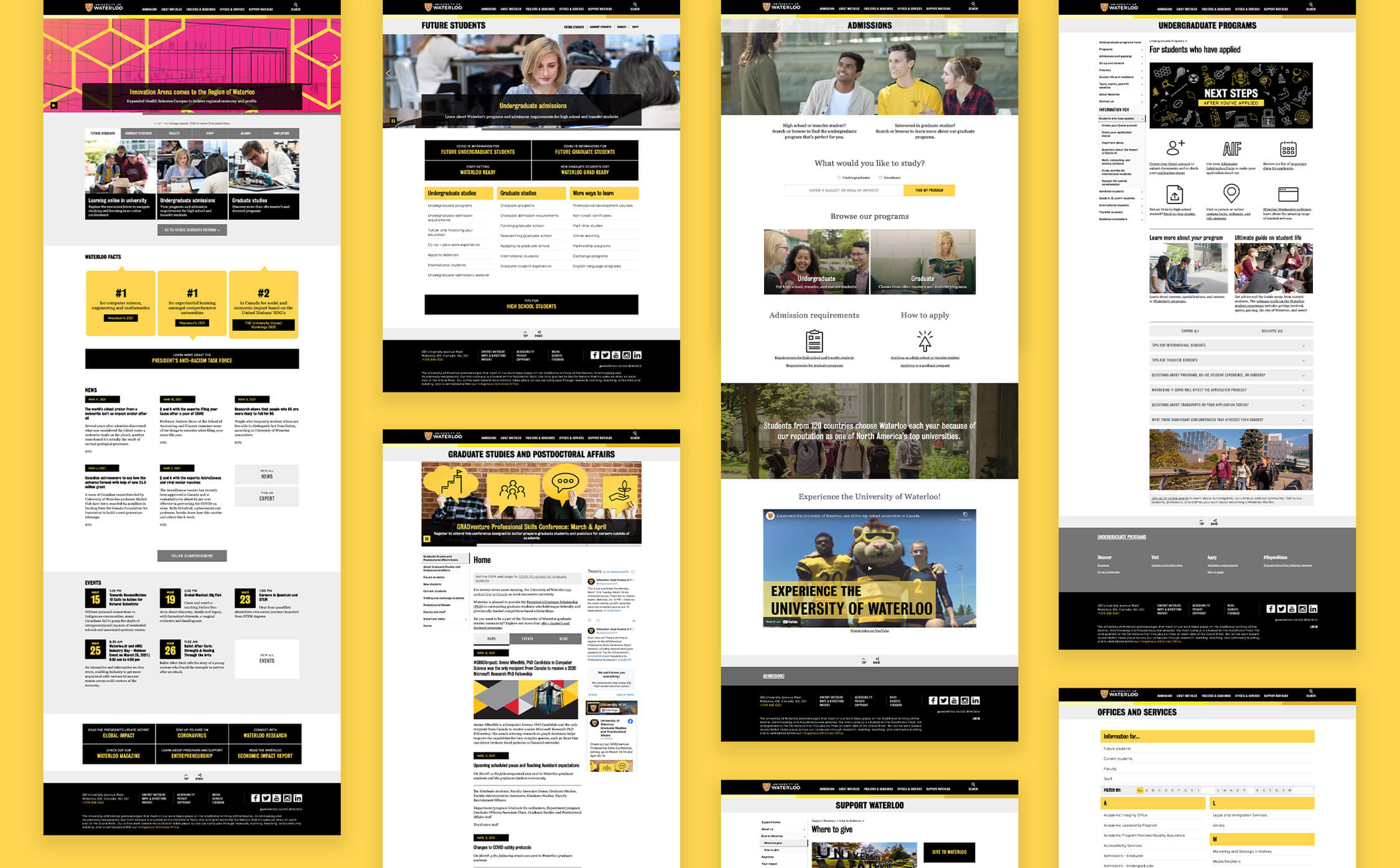
Drupal continues to be the platform of choice for The University of Waterloo – one of Canada’s top public research universities, with a culture of innovation and a history of nurturing entrepreneurship. Evolving Web guided the University of Waterloo throughout a large-scale platform migration from Drupal 7 to the latest version of the CMS. Our team worked with the University’s in-house developers to audit the existing platform, identify migration challenges, and create a plan for migration, maintenance, and change management. The resulting recommendations untangle the migration of Waterloo’s enormous and complex platform, improve user experience, and streamline ongoing maintenance.
In the second phase of the project, our team put together a migration toolkit to enable the migration itself. The toolkit underwent rigorous testing to ensure it would be functional across the University’s extensive portfolio of content-heavy sites.
About the project
Goals
Waterloo had been running its 950 sites on a single Drupal 7 multisite system. With Drupal 7 approaching “end of support” (end of maintenance, updates, and security support), the school initiated the process of moving to the latest version of Drupal.
In addition to modernizing the codebase, Waterloo sought to simplify its system and content architecture, better serve its content maintainers, and streamline and improve platform maintenance.
Evolving Web’s mandate comprised two phases:
- A discovery phase, during which we would provide an in-depth analysis of the current and desired states of the Waterloo website portfolio in order to make recommendations
- The creation and extensive testing of a migration toolkit for Waterloo’s 900+ sites

Challenges
The scale and complexity of Waterloo’s initial platform introduced significant challenges. The codebase shared by its 950 sites includes approximately 400 contributed and custom modules and a theme system with multiple layers of dependencies. This makes for tricky maintenance, with many interdependencies and potential conflicts.
The content architecture includes a large number of content types and widespread use of structured HTML with embedded entities for custom page layouts. A key hurdle in this migration is drawing out those custom page layouts from their current rich text fields and reworking them into Drupal’s new Layout Builder.
This complexity means that the team cannot rely solely on automated, out-of-the-box migration.
With hundreds of content maintainers and millions of monthly page views, it is critical that the move to Drupal 9 preserves data integrity and minimizes business disruption, all while meeting the deadline set by Drupal 7’s end of life.
Solution
Evolving Web guided the University of Waterloo in planning its large-scale platform migration of 950+ websites from Drupal 7 to the latest version of Drupal.
Our team also spearheaded the migration effort by developing and testing a comprehensive migration toolkit. Our approach to helping Waterloo achieve its goals focused tightly on simplification: simplified architecture, simplified migration and rollout, and simplified editor experience.
- Recommendations to reduce the cost of ownership and limit the differences between websites
- Recommendations to optimize the flexibility and usability for site owners
- Planning the transition from CAS to ADFS for user authentication
- Migration roadmap, with special attention to mapping the content to the Drupal 9 Layout Builder
- Creating the content migrations to move all 950+ websites from Drupal 7 to Drupal 9, including landing pages and Webforms
- Planning the automation of the deployment and migration process to a Pantheon Upstreams solution
- In-depth Drupal training for the Waterloo Web Services team
- Testing the migrations using automated testing tools, including our very own SiteDiff for content regression testing

Why Drupal was chosen
Higher education has been a driving force in the evolution and adoption of Drupal since its early days. Drupal is highly scalable, API-driven, fully customizable, integrates well with widely used tools and services, and implements today’s security best practices. It’s easy to see why 71% of the world’s top universities use Drupal. The latest version of the CMS includes features and tools for compliance with web accessibility standards, and the themes are designed to be responsive by default. Furthermore, as an open source platform with a thriving, engaged community of users and contributors, Drupal is well-suited to the spirit of collaboration and innovation that is so key to the University of Waterloo’s culture.

Technical Specifications
Drupal version:
Key modules/theme/distribution used: