Team Members
The United Nations Relief and Works Agency (UNRWA) is a relief and human development agency dedicated to providing assistance and protection to Palestinian refugees. Its work encompasses education, healthcare, social services, camp infrastructure, microfinance, and emergency assistance.
Vardot is a Drupal technology provider with offices in Jordan and the United States that provides digital business solutions for educational establishments, NGOs, SMEs, and media/news publishers.
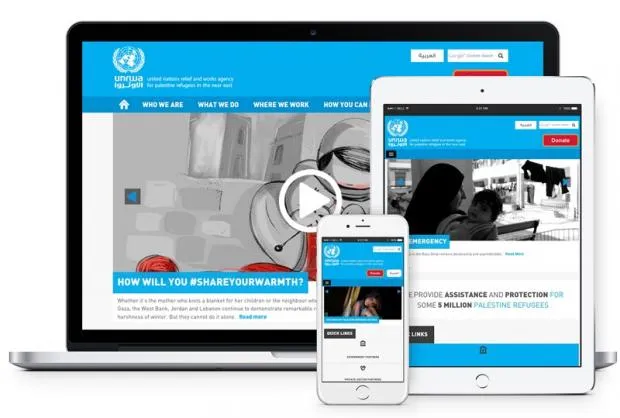
In 2013, UNRWA and Vardot collaborated to redesign and redevelop the agency’s website so that it could more efficiently provide outstanding service for refugees. The project’s principal objective was to build a platform capable of logically distributing news and press releases, multimedia resources, and program information while simultaneously reaching the agency’s broad range of target audiences.
About the project
The objective was to build a responsive, SEO-optimized platform with the capacity to handle a large number of content-types and layouts, and with a flexible layout manager to help manage the website easily; additionally, UNRWA needed two microsites and the infrastructure in-place to add more in the future.
Emanating from the precedent set by its old website, UNRWA designated several key areas as the primary goals for the project.
The first goal was to collectively improve user experience for its numerous target audiences: governments (traditional donors, non-traditional donors, Arab partners, host governments of refugee camps); philanthropists; NGOs and other UN Agencies; UNRWA’s beneficiaries (Palestine refugees and others it serves in Jordan, Lebanon, Syria, Gaza, and the West Bank); and opinion leaders (journalists, academics and ordinary citizens).
In order to do that, UNWRA’s website structure needed to be revamped so that it could customize individual content sections, index resources, include microsites, include an enhanced multilingual interface, and format it all in a logical and unobtrusive way so as to appeal to user groups with very different needs.
The requirements to meet the project’s goal of significantly improving the user experience were:
- A CMS with which administrators and content authors could easily utilize when creating and managing content.
- A CMS that allowed for field offices to log on to a restricted access account and draft content.
- Roles and permissions that allowed for content entry and content moderation.
- Responsive design in order to be compatible with various screen sizes, specifically those of tablets and mobile devices.
- Hosting the website on a new server with the capacity to handle at least 1,000 page requests per hour.
- Improving website security in order to maintain user and donor trust.
- Multilingual components: The website needed to allow for content to be published in both Arabic and English and permit users to switch between English and Arabic versions of the same article or page.
- Microsites: The website needed two microsites with identical layouts but individual branding, one for Arab donors, and one for vocational training centers; in addition to this, the infrastructure needed to be in place for the addition of future microsites.
Outcomes:
In September 2013, Vardot delivered UNRWA a fully scalable website built on Drupal 7 with SEO enhancements in place to increase search-indexing and search engine visibility.
Shortly after its launch, UNRWA’s new website was immediately put to the test, as the 2014 Israel-Gaza Conflict resulted in unprecedented numbers of visitors seeking out the agency online. From May to September of 2014, UNRWA experienced an uptick of nearly 60% in website traffic per month. Additionally, UNRWA’s website experienced a 50% increase in donations—before launching, donations amounted to roughly 5% of all website traffic, and that number rose to 10%.
The multilingual website was constructed expressly to meet increased traffic in times of emergency and the possibility of an overload of donations.
The website currently ranks in the top 1,500 in Jordan and in the top 600 in the Palestinian Territories, meaning UNRWA’s redesigned website is reaching its desired beneficiary audience.
And to this day, UNRWA continues to work with Vardot to ensure that its performance never lags, and that it is always cutting-edge.
Two years ago, we’ve selected Vardot to revamp and help us maintain our website and it’s a selection that we have been very happy about ever since.
Vardot has an exceptional professional team that is abreast of the latest innovations in web design and development and that has been very apt at helping us find solutions to our web communications needs.—Sami Mshasha, Chief of Communications, Spokesperson | UNRWA
Why Drupal was chosen
UNRWA sought a redesigned and redeveloped website running on a content management system with the capacity to improve website performance in several areas—and Drupal provided the required functionality to accomplish this. Although UNRWA’s source website—last redeveloped in 2009 on a PHP/MySQL platform—provided users with plenty of resources, it lacked a coherent structure and hierarchy; this limited user accessibility and made it particularly ineffective with regards to distributing crucial information in an effective manner to appropriate audiences. Additionally, as the agency’s target audiences speak a variety of languages (most notably English and Arabic) UNRWA needed a CMS with ample multilingual support.
This made Drupal an ideal choice for UNRWA’s digital needs: it’s an open source CMS with the ability to handle a large number of pages, content types, and permission levels while simultaneously affording flexibility and ease of use for users and editors to contribute. Additional factors include the nonexistence of a license fee and an extensive reservoir of dynamic modules that are both built and actively maintained by the Drupal community and Vardot.
Technical Specifications
Drupal version:
Key modules/theme/distribution used:
The main distribution used to enhance the usability of the administration experience is Varbase: Drupal Bundled with Necessities. Which also comes prepackaged with a lot of enhancements and best practices modules and features.
A few highlights are:
Navigation & Paths Management:
- Menu Block: To dynamically create menu blocks from menu hierarchy.
- Menu Position: The site consisted of many content types, and each was assigned in a specific section. This module managed the breadcrumbs trail for each content type.
- Path Breadcrumbs: Building breadcrumbs based on paths.
Mobile & Responsive Tools:
- Breakpoints: To build a responsive front end.
- Responsive Theme Preview: To allow editors to preview how the site looks instantly from the front-end for a number of preset device screen sizes.
- Responsive Menus: To generate mobile-friendly menu, given the large amount of menu links and hierarchy.
Usable Management & Administration:
- Entityqueue: To allows editors to easily sort content in displayed from views.
- Pathologic, Image Resize Filter, Linkit: A trio of input filters were used to correct paths in links and images in the content if the URL of the site changes or the content is moved to a different server.
- Drag & Drop Upload: Provides a drag & drop upload element and widgets for a file and an image field.
- Workbench: Improves editorial workflow by simplifying the interface for users who only have to work with content; allows user permission control based on organization-structure not website structure.
- Fieldable Panels Panes: Generates an entity that may be used in panel panes to create field-able entity panes using the Panels UI or a separate administrative UI.
Layout Management:
- Panelizer: Allows administrator to attach panels to any node in the system using multiple entity types, and choose which content and layouts are allowed.
- Display Suite: Drag and drop interface that smoothly controls how your content is displayed; for example, arranging your nodes, views, comments, user data etc.
Multisite:
- Domain Access: A suite of tools for running a virtual sites. Was used to implement CIRS website, yet provide one administration backend for both websites.
Multilingual:
- Internationalization and Entity Translation: To provide multilingual website.
Other key modules:
- Features: To provide standard best-practice management of configuration and site's features.
- Feeds: Allows users to import or aggregate data as nodes, users, taxonomy terms or simple database records.
Performance:
- Memcache: A memory caching system that speeds up dynamic database-driven websites by caching data and objects in RAM.
- HTTP Parallel Request & Threading Library: An API that other modules/code can use and sends out http requests in a parallel blocking or non-blocking way.