Sector(s)
Team Members
Project Team
Mobomo Team Members:
- Ken Fang
- Brian Lacey
- Shawn MacFarland
- Austin White
- Lucas Riutzel
- Orrin Rohrer
- Jason Schulte
- Sean Starnes
- Miles McLean
- Scot Self
- Kelly Jacobs
- Ted Stein
- Adam Barthelson
- Chris Wachtman
Other Team Members:
- Brian Dunbar (NASA)
- Ian Sturken (NASA)
- John Yembrick (NASA)
- Bob Jacobs (NASA)
- Jim Wilson (NASA)
Other Organizations
- NASA Office of the CIO
- NASA Office of Communications
- NASA EAST2 Web Services
- NASA WESTPrime
- AWS
Mobomo’s engineering team migrated nasa.gov to the AWS cloud and onto Drupal, creating a responsively designed user-centric webby-award winning experience, while bringing Drupal innovation to a portfolio of web properties across the agency.
The Mobomo team architected, implemented and deployed several AWS based Drupal CMS solutions for NASA to serve a wide variety agency needs, ranging from the agency flagship www.nasa.gov, to the Science Mission Directorate’s science.nasa.gov in both English and in Spanish, to a multi-site platform and governance model for 30+ Drupal applications serving groups across 7 NASA centers.
We migrated and relaunched www.nasa.gov and all of its subdomain components in just 13 weeks. Our team sunset an aging, closed source system, and replaced it with a Drupal based open-source CMS powered by AWS. The Migration effort included 250,000+ pages and nearly 3 terabytes (TB) of content. Relaunch occurred without downtime or service interruption.
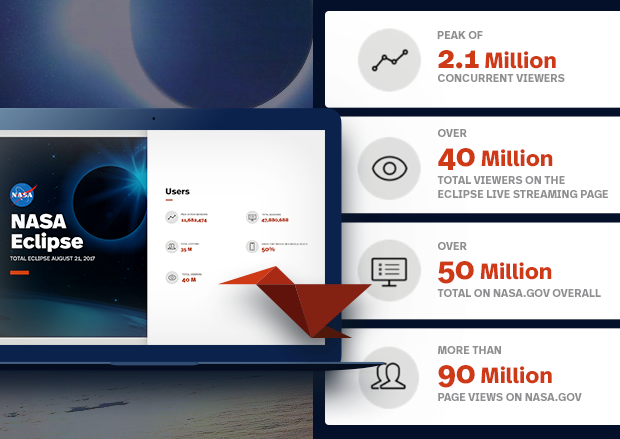
Since the beginning of our engagement with NASA, Mobomo has designed, developed and manage nearly 50 Drupal websites as well as continuously delivering cutting-edge enhancements in support of the agency’s most high-profile information campaigns and live stream events, highlighted by the 2017 Total Solar Eclipse , the largest web-traffic event in US government history serving 40 million viewers in the 6 hours of primary coverage.
About the project
Migrating www.nasa.gov to Drupal
Move Fast, No Disruptions
The Mobomo team were tasked with standing up an open-source CMS in the Amazon cloud to migrate the existing www.nasa.gov off of a proprietary, on-premise CMS system as fast as possible without causing any service interruptions for both content managers and public visitors.
Mobile First, User-Centric Design
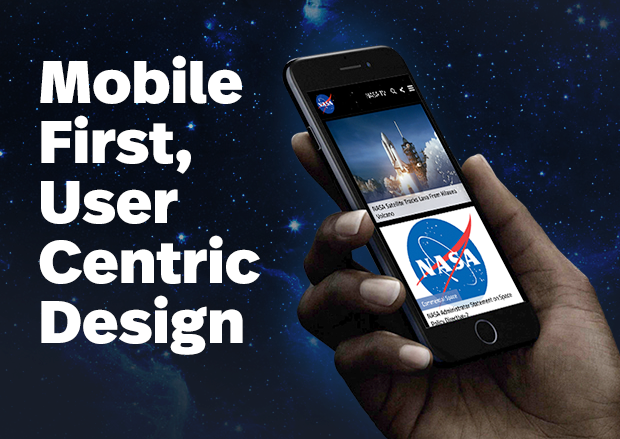
One of NASA’s key requirements for its new website was to develop a solution that offered both a modernized display as well as provide the same user experience on both desktop browsers and mobile devices. The Mobomo team employed a mobile-first approach to the redesign of www.nasa.gov, conducting numerous end-user interviews and experience-driven exercises such as CardSort and TreeJack to ensure optimal presentation of NASA content to the public. Mobomo’s efforts have resulted in the website being awarded the People’s Voice Webby Award for Excellence in 2014, 2016, 2017 and 2018. In the month that followed the launch of the website redesign, ForeSee metrics showed first-time visitors overall satisfaction increased from 77% to 81%, 80% strongly agreed the new site design was pleasing and 75% of all users had no difficulty navigating the site regardless of device type.
Build for Size and Speed
With www.nasa.gov averaging 1,000,000 page views a day, the Drupal website solution needed to be both highly available and a robust performing application to maintain a quality user experience. In addition to the high daily traffic, the Mobomo team also needed to account for live coverage events drawing even larger crowds of online visitors, as well as to scale down when the events concluded.
Innovate Constantly
Being known for its cutting-edge technologies and its public information campaigns, NASA needed it’s CMS solution to accommodate continuous integration with new technologies and services - both commercially available and custom built. This made Drupal an ideal candidate because of the strong development community and its ability to interface with the majority of social media and streaming services popularly used.
Architected for Success
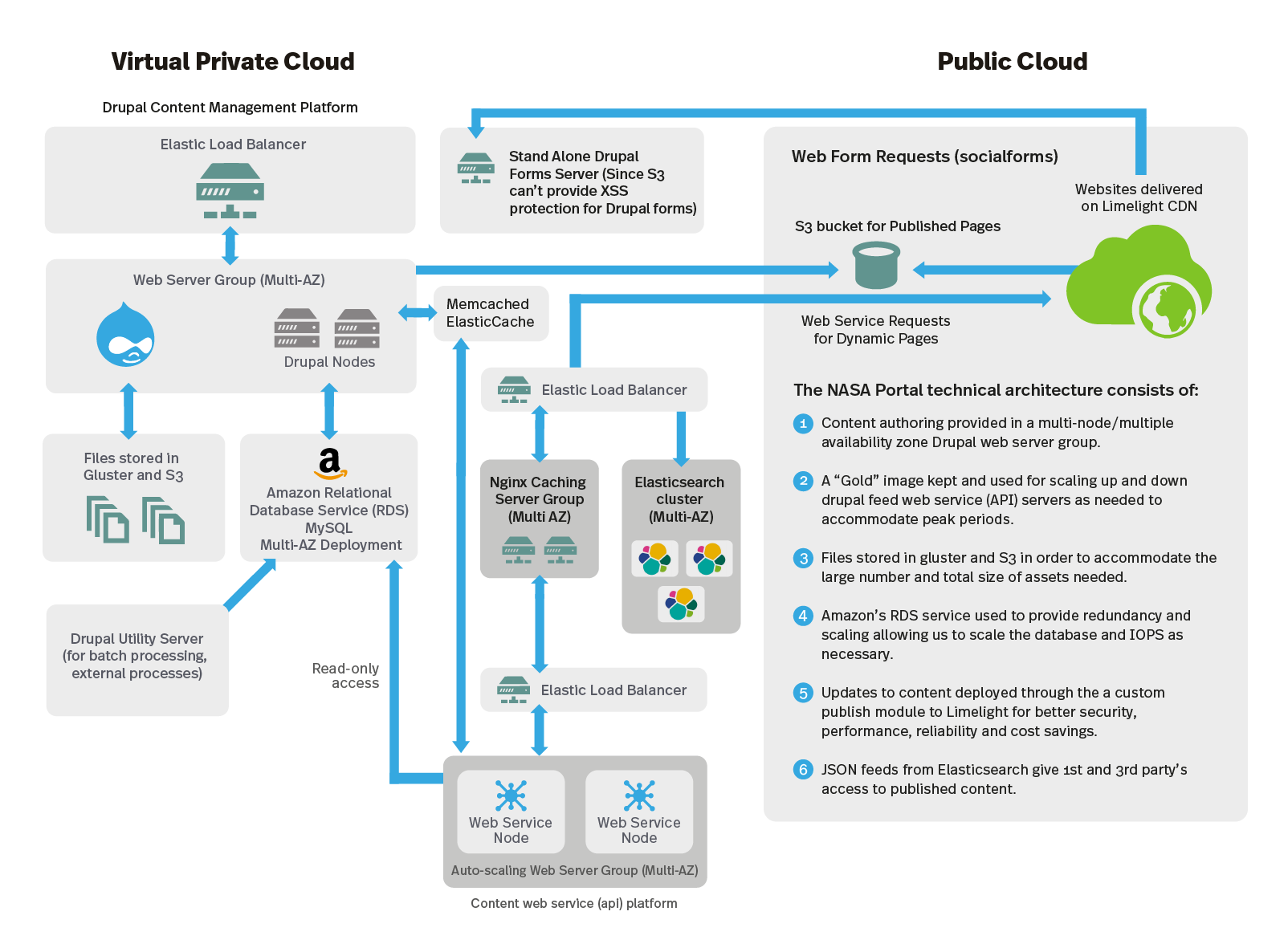
Mobomo developed the www.nasa.gov headless Drupal, AWS cloud environment with security, performance, and availability in mind. It is architected in a manner that separates the content management portal from the public website infrastructure to provide maximum security. It is deployed in multiple AWS availability zones for redundancy, handles nearly 500 content editors performing over 2,000 content updates a day, receives an average close to one million page views a day and has managed peak loads of over 40,000,000 page views in a single day with a record-breaking 2,000,000+ concurrent users during NASA’s 2017 Total Solar Eclipse coverage.
Why Drupal was chosen
- Proven Development Model
- Open-source code base and large contributor community
- Dramatic cost savings
- Scalability
- Security
- Role-based permissioning and workflow for tiered content management
When faced with the task of migrating NASA’s high-profile content, selecting the right content management system was fundamental to Mobomo’s successful endeavor. Drupal enabled Mobomo to compress the entire development timeline - designing, implementing and deploying the solution from development to production, while simultaneously saving NASA millions of dollars in annual savings. Building with Drupal on the Amazon cloud ensures that NASA’s content is securely stored and scalably available, while affording NASA the benefit of very flexible development capabilities when in designing, implementing and integrating new features and services.
With its user-driven APIs, dynamic host provisioning, infinite compute scalability and storage, well-architected security architecture, and continually developed robust new features, AWS and Drupal proved the perfect match to meet the content needs of both NASA and the public.
Technical Specifications
Drupal version:
Key modules/theme/distribution used:
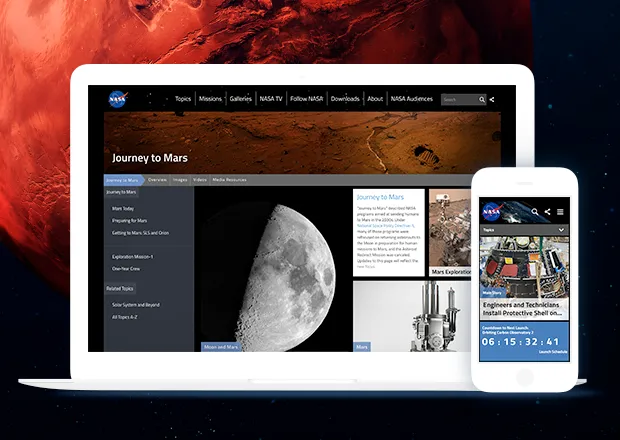
The core of the NASA.gov site is a headless Drupal front end which is powered by a combination of Elasticsearch and Services REST API. On the various Landing Pages of NASA.gov, including the home page, there is a grid of elements which make up a majority of the page. We call these elements Cards. Cards can be dynamically built with feeds of data or statically set via panel panes. This is possible with Panelizer allowing each Landing Page to have its own set of panes. We also wanted to have a large set of panes available to create cards and other elements. We created these pane varieties with Fieldable Panel Panes.
The content on NASA.gov utilizes the Scald media module asset management and embedded media. Scald was chosen for its robust support for configurable media embeds and flexible search utility which made it easy for editors to search only once through all the scald assets related to a piece of content and have that search list always available to pull into the various image and file fields.