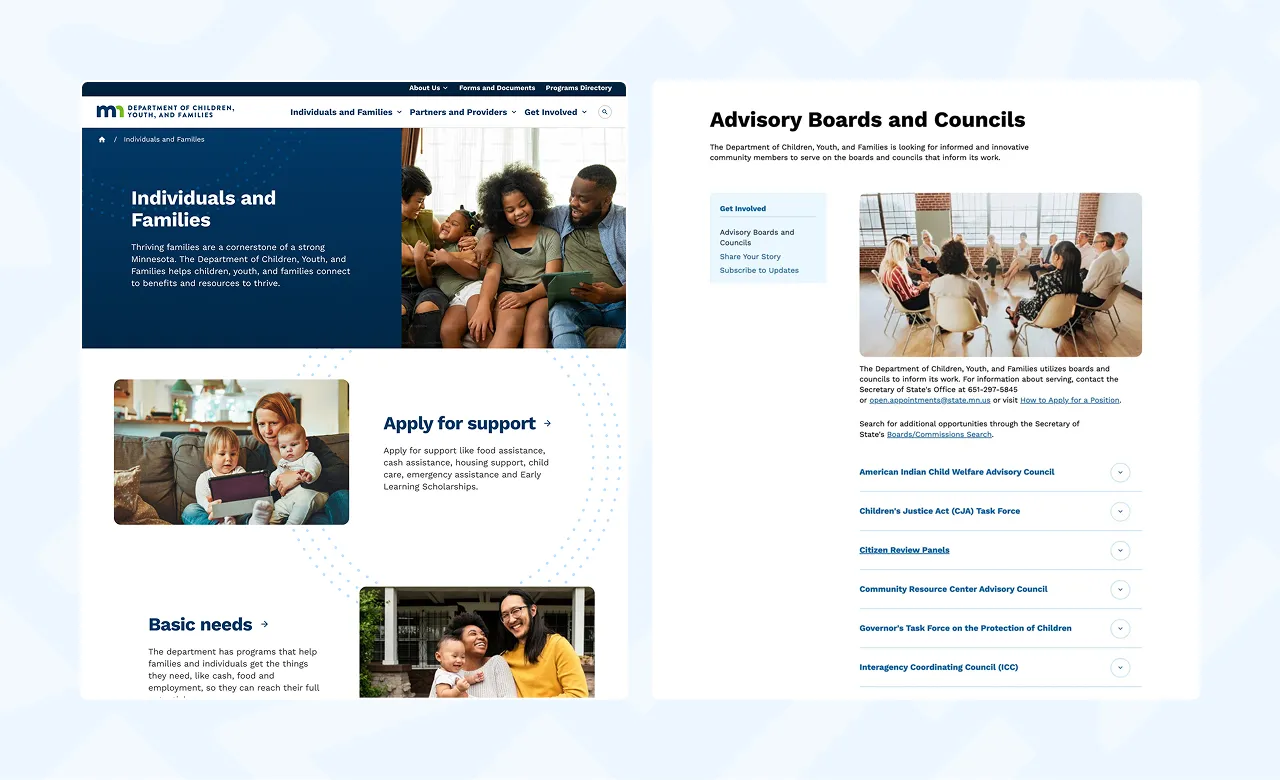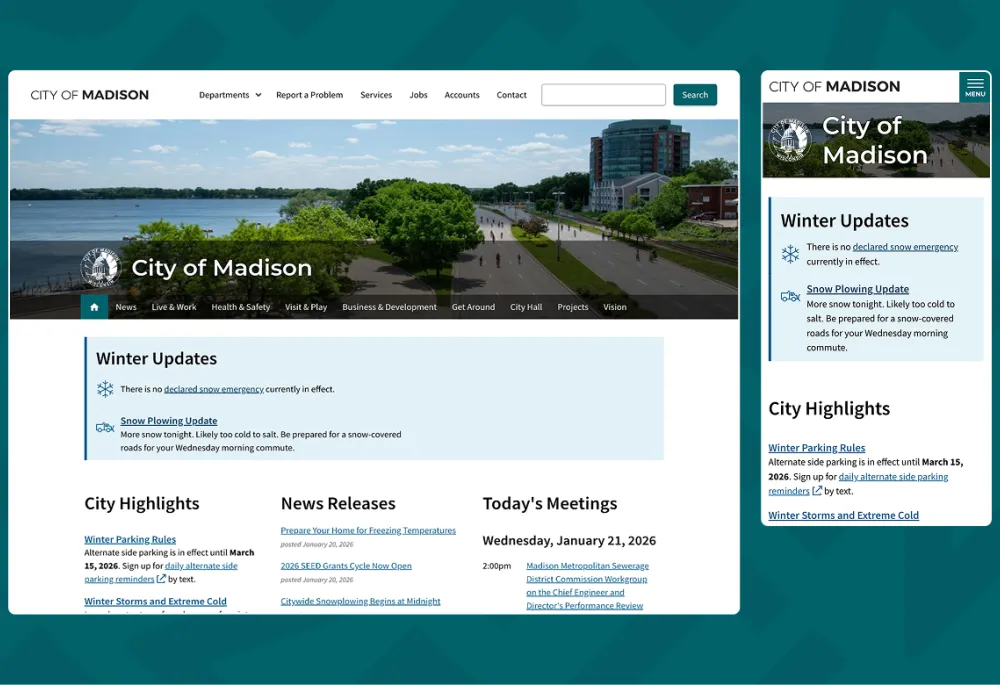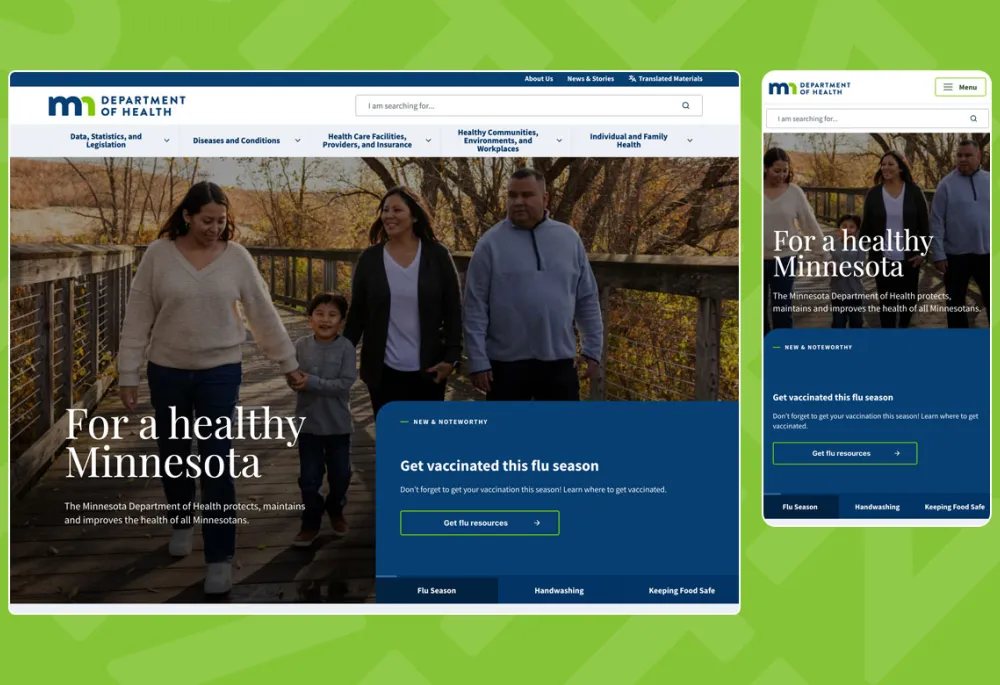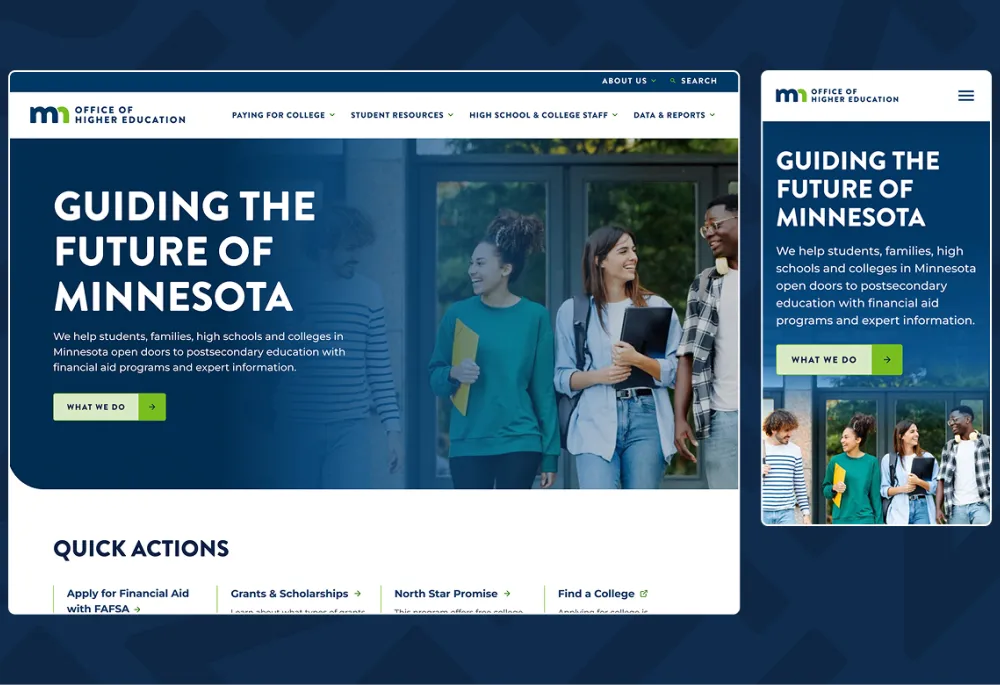
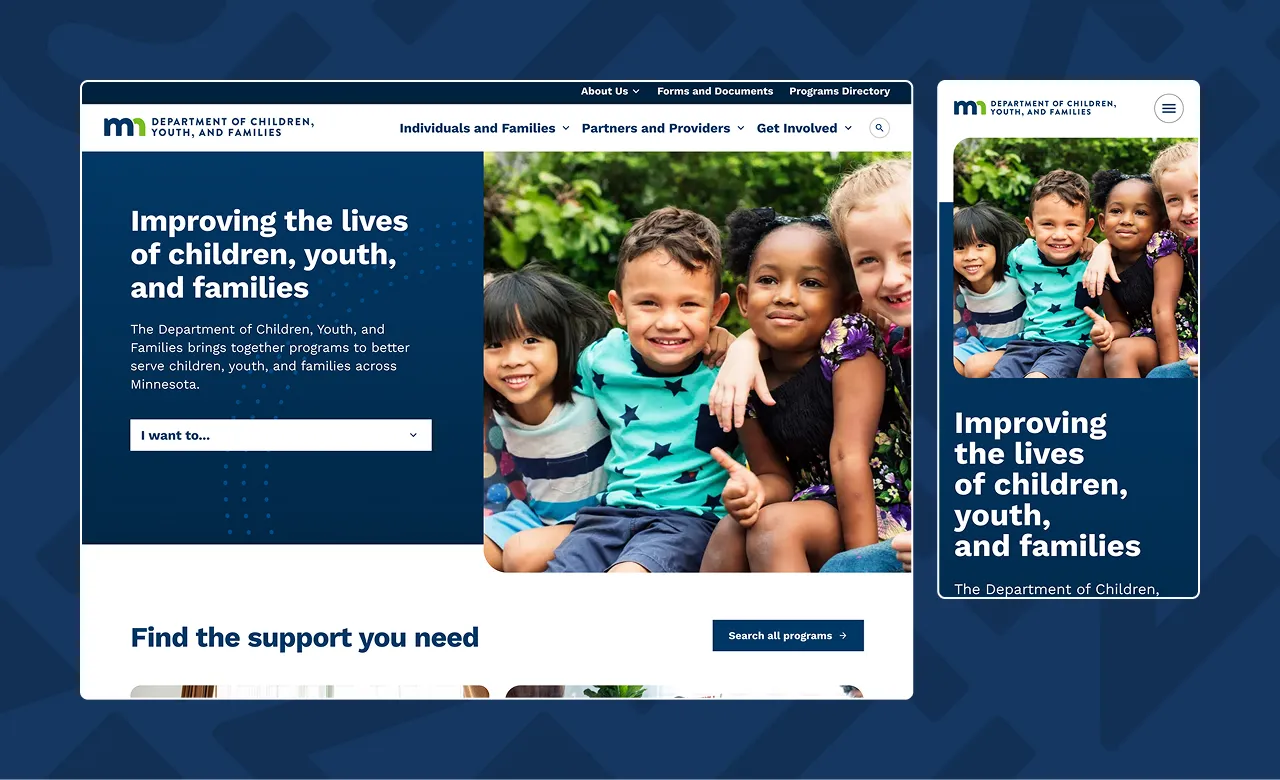
The Minnesota Department of Children, Youth and Families (DCYF) is the newest state agency in Minnesota, created during the 2023 legislative session to consolidate programs from four existing state departments: Education, Health, Human Services, and Public Safety. Its vision, in the State's own words, is a "clear front door for families" — extending to the website as a user-friendly, audience-centered digital experience for children, youth, and families in need of services and resources. DCYF's primary audience is Minnesota families, along with the child care providers, early childhood education groups, nonprofits, and other organizations that serve them.
Electric Citizen was selected to lead the website work based on our long history with government clients. When the engagement began in February 2024, DCYF had no existing website, no standalone brand, and a hard deadline: the agency was scheduled for a transitional public launch on July 1, 2024, with content from the four legacy departments continuing to transfer in through July 1, 2025. The initial site had to be planned, designed, built, and launched in under six months.
About the project
Challenge
DCYF faced three challenges at once.
The first was coordination. The department is a consolidation of programs and services from four existing Minnesota state departments — Education, Health, Human Services, and Public Safety — bringing together roughly 175 programs, multiple editorial teams, diverse audiences, and goals that had never lived under one roof before.
The second was design and branding. While part of the broader State of Minnesota brand system, DCYF was a brand-new department starting from scratch — with no existing website or marketing materials to build on.
The third was timing. As mission, staffing, leadership, and content details came together in late 2023, it became clear the agency needed a public website ready for its July 1, 2024 transitional launch — with content from the four legacy departments continuing to transfer in through July 2025. The initial site had to be planned, designed, built, and launched in under six months.
Solutions
Electric Citizen began by working with DCYF to define target audiences and organize site content and navigation around the needs of core users — primarily Minnesota families and the organizations that serve them, in service of the State's stated vision of a "clear front door for families." We advised DCYF on content types, fields, and taxonomy choices in Drupal, giving their internal team a clear structure for the manual content entry they led themselves across programs transferring from the four legacy departments.
On the design side, we led visual design for the site within the State of Minnesota's broader brand framework, focused on a warm, human-centered approach that puts kids and families front and center. On the build side, we delivered a Drupal install focused on stability, accessibility, and scalability, with a content model tuned to DCYF's program catalog and audience-first navigation.
To hit the six-month initial deadline, we worked with DCYF on a tightly scoped work plan: a shortened feedback-and-revisions cycle, a crisp definition of what would be in the launch release, and a parallel "phase two" backlog for improvements to be tackled after the agency's public launch — including the steady stream of content that continued to transfer from the four legacy departments through July 2025.
Outcomes
Despite beginning the project in mid-February, the DCYF site launched on time for the agency's July 1, 2024 transitional public launch — on schedule and under budget. In its first nine months, the site served nearly 500,000 users, giving Minnesota families a single online resource where they previously had to navigate four separate state departments for the same information.
Electric Citizen continues to support DCYF with additional features and improvements following launch.
This work was performed for the Minnesota Department of Children, Youth and Families under the State of Minnesota's MNSITE contract program. It is a factual description of a completed project and does not imply the State's endorsement of Electric Citizen or its services.
Why Drupal was chosen
Drupal was specified in the State of Minnesota's contract for the DCYF website, reflecting Drupal's well-established role across Minnesota state agency websites. It was a strong fit for this project for several reasons:
- Content scale and structure — DCYF consolidates programs and services from four different parent state departments — Education, Health, Human Services, and Public Safety. Drupal's mature content modeling, taxonomy, and entity reference capabilities are well suited to the kind of structured, audience-driven program catalog a consolidation like this requires.
- Editorial empowerment across many content owners — A site like this has multiple internal editors representing different programs and audiences. Drupal's role-based permissions, reusable components, and well-designed authoring experience make it practical for a distributed editorial team to maintain a shared site.
- Accessibility — As a public agency website serving Minnesota families — including underserved families, families with disabilities, and families with varying levels of digital literacy — accessibility was essential. Drupal's accessibility-focused core and admin experience support sustained WCAG compliance.
- Open source and sustainability — No licensing costs, a large contributor community, and a clear long-term roadmap make Drupal a sustainable choice for a new public agency with a multi-year horizon.
- Sector fit — Drupal is broadly adopted across U.S. state and local government, offering proven patterns for multi-audience, multi-program agency sites and a ready pool of expertise on both sides.
Technical Specifications
Drupal version:
Key modules/theme/distribution used:
DCYF's content challenge was consolidation: 175 programs, multiple internal editors, and a brand-new site with no prior structure to inherit. Getting the content model right from day one was the core of the build. Paragraphs and Layout Builder give editors a flexible, component-based authoring experience for pages across the program catalog, and Media Library centralizes image and asset management so editors across programs pull from a consistent library.
With the content itself being entered manually by DCYF's internal team across a short timeline, the foundational work was defining the right content types, fields, and taxonomy for the program catalog. Once that foundation was in place, Pathauto kept URLs consistent and human-readable across hundreds of programs, and Redirect was used to manage inbound links arriving from the legacy parent department sites.
As a new high-visibility public agency website, the site also had to be easy to find and easy to search. Metatag support SEO for an agency whose content is actively being discovered for the first time. Search API powers on-site search across the program catalog, so families looking for a specific benefit or program can find it without knowing which parent department it used to live in. The Gin admin theme rounds things out with a cleaner, more accessible editing experience for the distributed team of editors maintaining the site day to day.