Sector(s)
Project Team
Other organisations involved:
Team members:
- Con Fountas - Engagement Manager
- Alfred Deeb - Relationship Manager
- Kristen Pol - Business Analyst and Technical Lead
- Stuart Rowland - Solution Architect
- Steve Worley - Solution Architect
- Chris Darke - Backend Developer
- Alan Cole - Frontend Specialist
- Anand Toshniwal - Frontend Developer
Visit the site
Visit the siteOrganizations Involved
Community contributions
During this project we made the following contributions:
- Small contribution (patch review): https://www.drupal.org/project/drupal/issues/1903010#comment-14447095
- Small contribution (provided patch for specific version): https://www.drupal.org/project/drupal/issues/3031271#comment-14453677
- Tested and reviewed: https://www.drupal.org/project/link_attributes/issues/2939514#comment-14472194
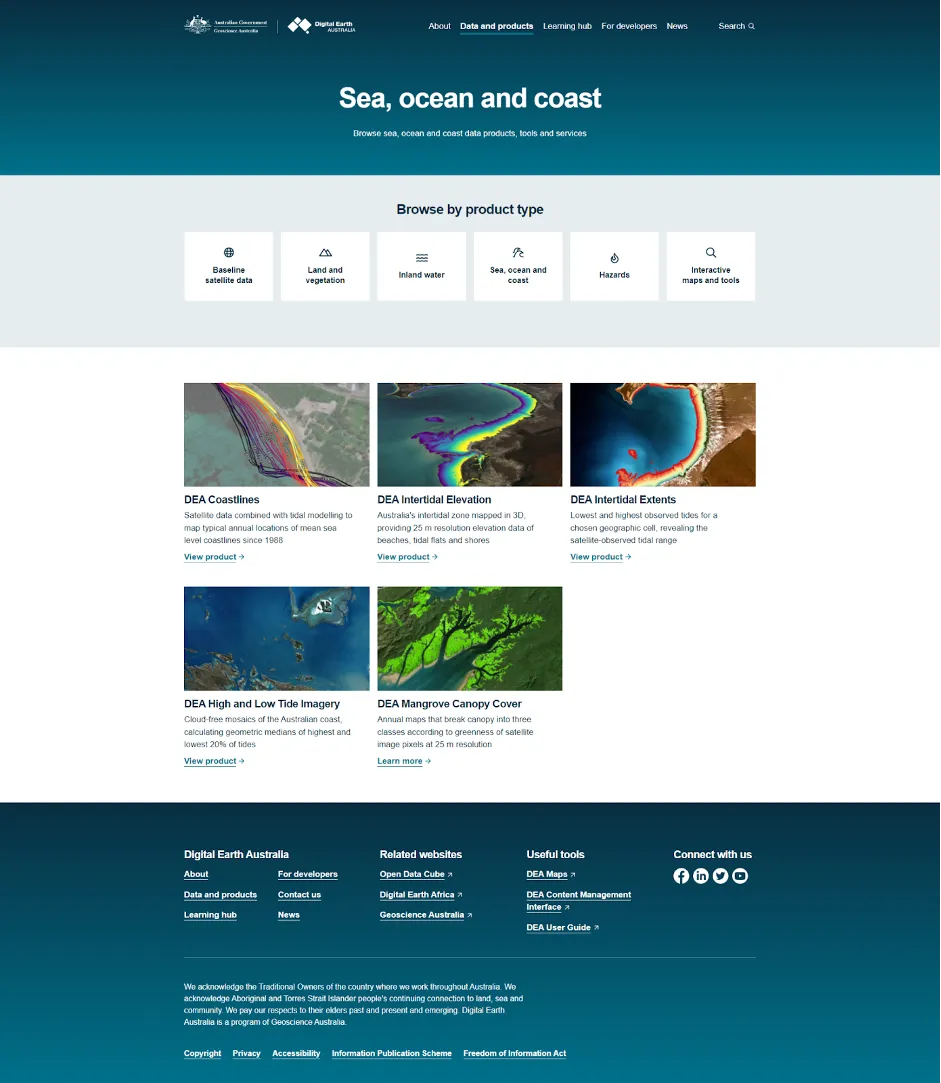
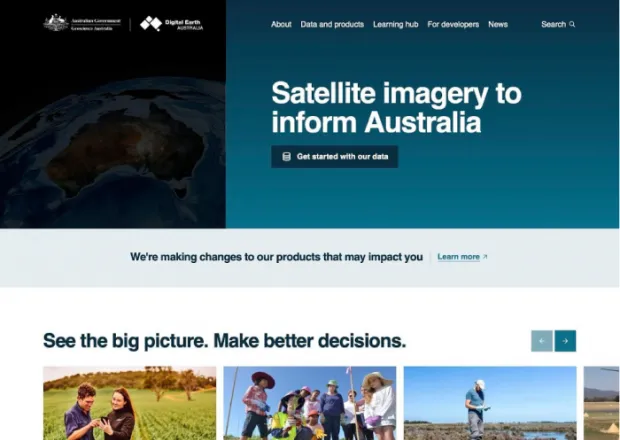
Salsa Digital worked with Geoscience Australia to recommend a modern architectural solution. The solution needed to deliver Australian earth data as discoverable and consumable information to citizens, industry and academia. The Digital Earth Australia pilot is part of a broader vision to consolidate and better leverage all Geoscience Australia digital assets.
About the project
Geoscience Australia's challenge
Geoscience Australia’s websites were using different CMSs and technologies, hosted on a range of different infrastructures. They wanted to remove the technology fragmentation and barriers in the discovery, management and correlation of data.
Geoscience Australia's transformation
Salsa Digital worked with our creative partner Today.design, Geoscience and GovCMS to pioneer new government digital platform approaches. Geoscience Australia’s Digital Earth Australia (DEA) site forms the pilot of a broader objective to generate efficiencies and savings for Geoscience Australia. This pilot project and the platform were built in five months using agile project methodology.
The focus is on modern architectures to address the duplication of features, content, user experience, platform hosting, website maintenance, integration and other operational costs.
The next-generation platform provides both a standard backend editing experience, as well as a cohesive design system to ensure consistency across all sites. It also greatly lowers the barrier when new sites need to be created.
It’s based on technical approaches such as:
- Headless — Content is maintained on a GovCMS (Drupal) environment and exposed via an API. This API is then fed into a design system (built with Vue.js) to render web content in a decoupled manner.
This architecture allows the Drupal backend to run in a more secure context, as it doesn’t need to be exposed to the general public.
- Static — The design system uses Nuxt.js to generate static output for the website data provided via the API. This output is then pushed to QuantCDN — a global edge engineered for the static web.
Website visitors interact with this static output (e.g. the compiled HTML/CSS/JS), which represents the ultimate in security, performance and scalability.
When content changes in the backend, the content is compiled and pushed to the static CDN, so it’s always up to date.
The outcomes
-
A more customer-centric experience so it’s easier for citizens, industry and academia to discover and use Australian earth data
-
Efficiencies and savings through consolidation
-
High security and platform resilience through uplifting people (skills), process and technology
-
Introduction of static web and headless (decoupled) approaches
Why Drupal was chosen
Drupal is the CMS of choice for the Federal Government in Australia, through the GovCMS platform. SSalsa Digital recommended GovCMS for Geoscience Australia for three main reasons:
- GovCMS was looking to create a decoupled/headless capability within the platform, which aligned well with Salsa Digital’s technical recommendations
- GovCMS and Salsa Digital had also been discussing the next generation GovCMS being decoupled plus static Drupal and the static implementation would increase security and IRAP coverage (Australia’s cybersecurity assessment process) for Geoscience Australia
- This implementation would allow Geoscience Australia and GovCMS to lead the way in the Australian GovTech landscape
Technical Specifications
Drupal version:
Key modules/theme/distribution used:
GovCMS was chosen as a mature, whole-of-government Drupal solution that was moving to a headless and static implementation.
Paragraphs was chosen to map to the decoupled Vue.js frontend components. LinkIt and Quick Node Clone were added to enhance the Drupal editing experience. Decoupled Router and several JSON:API modules were used to get the structured content from Drupal into the frontend components.