Sector(s)
Project Team
Team members:
Paul Morriss
Alex Skrypnyk - Solution Architect
Julie Erben - Engagement Manager
Richard Gaunt - Technical Lead
Alan Cole - Frontend Developer
Nick Georgiou - Frontend and Backend Developer
Sonny Kieu - Backend Developer
Kate Swayne - QA
Salsa worked with a leading federal agency to deliver its new portal. The portal manages and distributes sensitive data to Australian government agencies.
About the project
The challenge
A federal agency (that can’t be named for security reasons) was running its portal on an old version of MS SharePoint. The portal had a high cost of ownership, many functional gaps, was slow to respond, and was visually unappealing to the user. It was no longer fit for purpose.
The transformation — a secure, flexible, engaging portal with lower cost of ownership
The agency’s transformation focused on:
- A user-centric design (UCD) process for visual design
- Architecting the portal for security
Salsa’s creative partner Oliver Grace led the design process to ensure the final portal was visually appealing and user-centric.
The portal needed to launch at ISM OFFICIAL: Sensitive. Salsa drew on our experience securing whole-of-government digital platforms such as GovCMS and Victoria’s Single Digital Presence to launch the portal with the required security.
Project delivery blueprint
The project was, and continues to be, a significant program of work. A rigorous transition-in and service delivery plan was required. Salsa designed a delivery model to meet the federal agency’s needs.
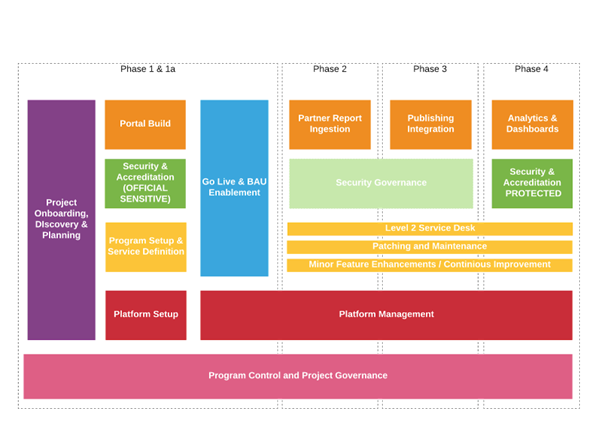
The project was broken into four key phases:
- Phase 1 — A new portal with interim capability, migration of 140K content pieces and phase 1a enhancement sprints (complete)
- Phase 2 — Migration of existing 1.2TB of data and build of new report system (complete)
- Phase 3 — End-to-end integration with the existing publishing system (upcoming)
- Phase 4 — Creation of business intelligence reports (upcoming) and ISM PROTECTED (descoped)
Each phase is being delivered as discrete agile projects, with their own discovery, planning, build, UAT and go-live.
A series of service streams addressed critical aspects of the project, namely:
- Portal build (orange) — Delivering the technical solution across each phase
- Security and accreditation (green) — Delivering phase 1 to OFFICIAL: Sensitive
- Program services (yellow) — Establishing tools and processes, and support for the program post phase 1 launch
- Platform management (red) — Establishing the secure, dedicated infrastructure
- Program control and governance (pink) — Coordinating activities across the streams during each phase
Security design
The federal agency portal manages sensitive data shared with authorised government agencies and partners. Given this, it was imperative that the new portal was appropriately secured. The Australian Government Information Security Manual (ISM) is a framework used to apply risk-based management to protect systems and data from cyber threats. The launch pathway was starting with ISM OFFICIAL: Sensitive.
Salsa’s security design included:
- Using a dedicated cluster to host the portal for the highest level of isolation from cyber threats.
- Ensuring production data is only used in relevant environments (production and staging) with all other environments using sanitised data.
- Using processes and systems from Salsa’s GovCMS experience where appropriate — Salsa had previously led the accreditation of GovCMS to ISM OFFICIAL: Sensitive (see GovCMS security case study). This knowledge and experience was used as a baseline for this project.
- Designing for security at every level — The Drupal application is architected for security requirements, as are all the processes, people and technology involved.
- Using the following services via amazee.io:
- Fully managed content delivery network (CDN)
- Fully managed next-gen web application firewall (WAF) (formerly Signal Sciences)
- Origin shield
- The service enables origin to only accept traffic from the CDN or a pre-approved IP list, which has passed high level WAF rules.
Salsa worked with the client to perform an IRAP assessment. More details are in our dedicated security case study.
UCD process
The team at Oliver Grace (OG) followed a user-centric design process to design the portal with users in mind. Interviews with representative users and testing user journeys on early prototypes allowed validation of assumptions and iteration of the design. Salsa, OG and the client built confidence in the user experience prior to investing in the build (per DTA best practice service design).
Functional discovery
Salsa worked closely with our client to structurally review each area of the project scope. We then re-iterated functional JIRA stories for approval by the product owner. Areas of discovery included:
- Desired report functionalities, e.g. the ability to create a PDF from the data, the ability to display related data, the ability to click on data tags that would take the user to the search page with the relevant topic filter set, the need for automatic ID generation, etc.
- Desired landing page features, e.g. the ability to set automated filtered listings, the ability to promote content, the ability to add manual references to other portal pages, etc.
- Desired workflow for content editors so content authors can review and approve each other’s work for publishing.
- Subscriptions, so users can subscribe to specific data and receive the relevant alerts.
- Editorial improvements, e.g. the ability for content authors to select data published on the day and automatically generate a compilation of this data, automatically grouped based on a primary tag set.
- The ability for the end user to provide feedback on the data, which is then relayed back to the individual authors.
- Integrating the portal with another system, which would need to ingest data published in the new portal.
- Generating draft data from an external source via a text file that’s generated from an external system.
- Desired search requirements for editors and users.
- Migrating 140K+ data assets from the predecessor with varying data models and validating this migration.
- Desired login model for the portal.
Content data model
One of the early challenges of the project was to build a content data model. We needed to understand exactly how all the associated metadata correlates. This allowed us to build confidence that the system’s foundation was solid and we’d be able to support all the use-cases — for the frontend users, the content authors and the site administrator. We approached this with great attention to detail as we knew that if the setup wasn’t right we could easily be blocked. Only once this data model was reviewed and approved by relevant stakeholders did we move on to building the solution.
Development
Salsa used agile methodology to deliver the project incrementally, demoing the status quo every two weeks and allowing the client to do user acceptance testing (UAT) incrementally as well. This allowed Salsa to flexibly react to changing requirements and to learn more about the user and editorial needs throughout the project. Larger changes in scope were managed together with the client, allowing us to share the risk and progress.
Data storage and migration
There were over 150,000 content items that needed to be migrated. This included pages, images and documents.
The pages were loaded from CSV provided by the client.
The process involved mapping the old content model to the content model we had created.
We used Drupal's core migration and migration plus modules to read the source data and provide a set process plugins to transform the data (remove Sharepoint-related data structures), migrating media items and links included in HTML.
We ran migrations on a nightly basis using a review, update, test and refine migration feedback loop —reviewing the source documents for data features we needed to test, updating the migration script for these new data requirements, testing the results and refining the migration script as needed until we had a final product.
Training/stakeholder testing
As we were reaching the end of phase 1, we started to draft the training materials for the various roles — member, content author and site administrator. This also put us in a great position to deliver preliminary training to a pool of content authors, which meant they could properly test the system prior to launch with enough time for us to make minor amendments. A final training session and in-depth documentation was then delivered closer to the go-live date.
Next steps
Now that the portal has launched and is being used every day, opportunities for small optimisations appear. We also continue to review the overall solution evaluating where greater efficiencies can be achieved and processes and implementations can be optimised.
We have officially entered business as usual (BAU) mode, which means that we’re handling support requests, updating modules on a monthly basis and applying security patches as they become available.
The outcomes — a secure, more engaging portal
- A new, user-focused portal with improved visual design
- An advanced experience for content editors
- Greater control on landing pages and the ability to promote content
- Improved portal security, performance and usability
- Migration of 1.1 million data assets, onto the new portal with relevant metadata
- Better search functionality
- No licensing fees and a lower cost of ownership
- An effective support model for portal support and maintenance
Why Drupal was chosen
When Salsa responded to the tender for this work, we proposed building on Drupal. The federal agency liked our proposal, which focused on an open source, secure, authenticated, flexible, easy-to-integrate, easy-to-extend (via modules) and well-established platform.

Technical Specifications
Drupal version: