Sector(s)
Team Members
The Wallace H. Coulter Department of Biomedical Engineering (BME) is one of the leading biomedical engineering programs in the country, jointly managed by Georgia Tech and Emory University. The department brings together the research strengths and educational traditions of both institutions to advance biomedical innovation.
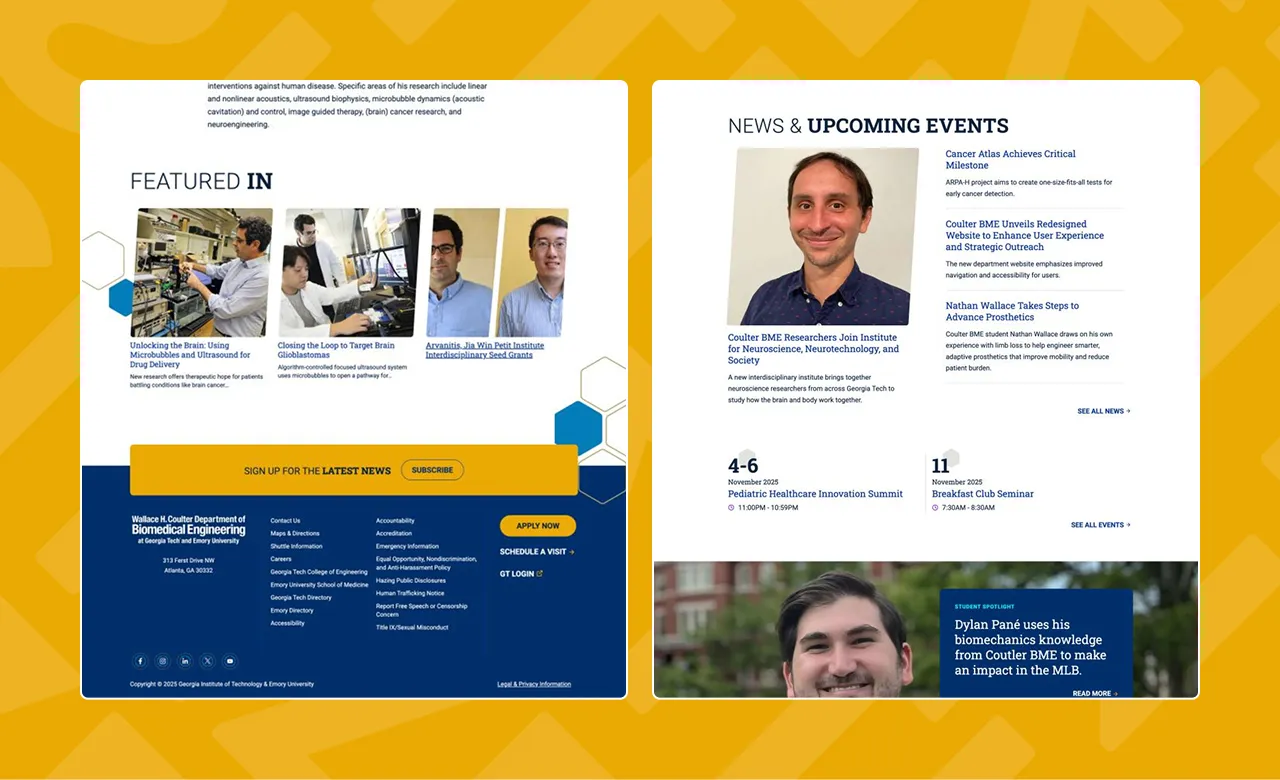
Its existing website — running on Drupal 10 — had evolved over several years into an internally focused information repository. Navigation lacked a cohesive architecture, the copy was long and unfocused, and the design didn't successfully reconcile the two parent institutions' brand systems. A growing ecosystem of roughly 14 separate WordPress sites for academic programs added further fragmentation. The department engaged Electric Citizen for a full redesign and rebuild on Drupal to attract top prospective students, better tell the story of the program's impact, and consolidate content into a single, well-architected home.
About the project
Challenge
To stay competitive in a growing field, BME needed to attract top students and highlight the outcomes and impact of its alumni and research programs. The existing site wasn't up to the task. It lacked a cohesive architecture, navigation was difficult, and the copy was long and unfocused. The design didn't effectively represent the joint Georgia Tech–Emory identity. Behind the scenes, the site had been maintained by a single developer, limiting scalability and modernization. Content was also fragmented across roughly 14 separate WordPress sites for academic programs. BME needed an experienced web team to strengthen the technical foundation, improve usability, and better tell its story online.
Solutions
Electric Citizen partnered with BME on a full website redesign — spanning research, strategy, design, copywriting, and development. We began with a comprehensive content audit and inventory, paired with analytics review, stakeholder interviews, and a community survey, and used the findings to build a content playbook organized around the department's audiences and content pillars of innovation, impact, and life-changing research.
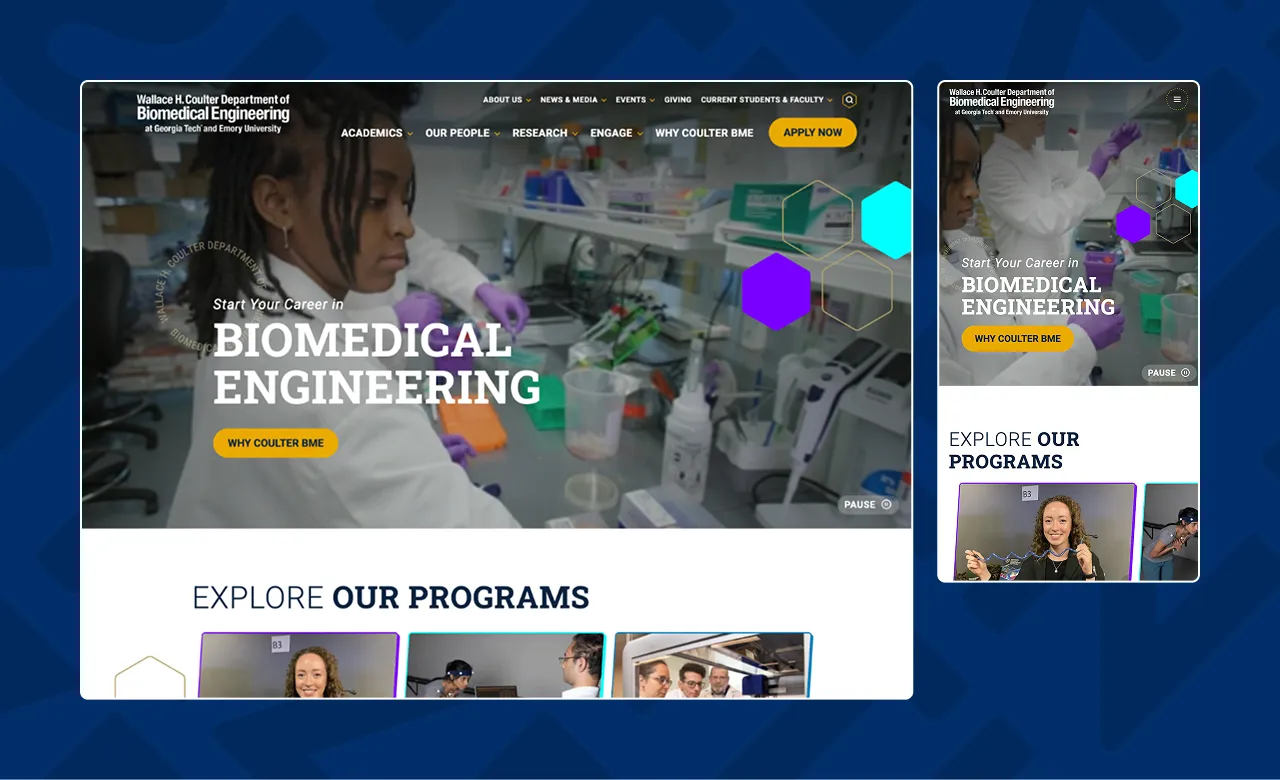
With strategy in place, we restructured site navigation around five core areas — Academics, Our People, Research, Engage, and Why Coulter BME — and added clear calls to action and logical pathways for prospective students, faculty, and partners. Our design team built a unified visual language drawing from both Georgia Tech and Emory palettes while keeping a neutral, modern aesthetic distinctly BME. Component-based design makes it easy for editors to build new pages consistently, and every page was designed and built to meet WCAG 2.2 AA. Subtle animations, geometric "science-inspired" shapes, and interactive media elements add engagement without getting in the way.
On the backend, we built a new Drupal installation focused on stability, accessibility, and scalability — and, just as importantly, on sustainable engineering practices the previous install had lacked: version control, configuration management, automated testing, local development environments, and dedicated dev / test / stage / production environments on a managed host. We migrated existing profiles, news, and events from the previous Drupal site — using the Migrate suite for structured content and manual re-entry where content was reviewed and cleaned up as part of the move. Our team also collaborated closely with BME to rewrite and refine roughly half of the site's copy, including academic program pages and research areas, grounded in the content playbook.
Outcomes
The redesigned site launched with measurable gains:
- 25% increase in engagement rate
- 50% improvement in desktop performance
The result is a stronger digital presence for the department — a more usable, accessible, and high-performing site with a refreshed visual identity and a content management experience that empowers the BME web team to maintain and grow the site on their own.
Why Drupal was chosen
BME was already on Drupal 10 when the project began, but the existing install had been built and maintained by a single developer without the engineering practices a site of this scale and importance needs. The real decision point wasn't Drupal vs. another CMS — it was whether to continue on Drupal under a modern, team-supported setup, or migrate to a different platform.
Ultimately we recommended they remain on Drupal for the following reasons.
- Content scale and structure — The site supports faculty and staff directories, research areas and facilities, academic programs, news, events, job listings, giving, and publications. Drupal's mature content modeling, taxonomy, and entity reference capabilities handle this kind of multi-audience higher education site well.
- Editorial flexibility — A key complaint with the prior build was a theme that limited what editors could do. Drupal's component-based authoring model, paired with the right contrib modules, gave us a path to fix that without leaving the platform.
- Engineering practices the existing install lacked — The rebuild gave us an opportunity to put the site on a professional footing: version control, configuration management, automated testing, local development environments, and dedicated dev / test / stage / production environments on a managed host. Drupal's maturity and tooling made that straightforward.
- Accessibility — As an institution serving prospective students, current students, faculty, and partners, the site had to meet WCAG 2.2 AA. Drupal's accessibility-focused core and admin experience support sustained compliance.
- Sector fit — Drupal is widely adopted across U.S. higher education, which means proven patterns for department sites, research content, and people directories — and a community that understands the constraints of joint-institution work.
- Open source and sustainability — No licensing costs, a large contributor community, and a clear long-term roadmap make Drupal a sustainable choice for a department with a multi-year horizon and multiple parent institutions involved in governance.
Technical Specifications
Drupal version:
Key modules/theme/distribution used:
A central complaint with the prior build was an editing experience that didn't give content authors enough flexibility. Paragraphs, Layout Builder, and Media Library together give editors component-based pages, higher-level layout control where it's needed, and a single place to manage embedded media — the foundation of a site the BME web team can grow on their own.
Even though BME stayed on Drupal, the rebuild still required a meaningful content migration. The Migrate suite provided the scaffolding to move structured content — profiles, news, events — into the new build programmatically, while a portion of the content was reviewed and re-entered manually so the team could clean it up as part of the move. Pathauto and Redirect protected SEO equity and inbound links through the transition.
As a recruiting tool for a top biomedical engineering program, the site had to be easy to find and easy to search. Metatag and Schema.org Metatag support SEO and structured data. Search API and Search API Solr power site search tuned to BME's content — research areas, faculty directories, academic programs, and news. The Gin admin theme rounds things out with a cleaner, more accessible editing experience for staff managing the site day to day.