Sector(s)
Project Team
Other organisations involved:
Department of Communications and the Arts website
Team members:
- Paul Morriss - Engagement Manager
- Roman Barbun - Technical Lead
- Alan Cole - Senior Frontend Developer
- Awang Setyawan - Frontend and Backend Developer
- Sonny Kieu - Senior Backend Developer
- Govind Malu - Backend Drupal Developer
- Rose Duong - Designer
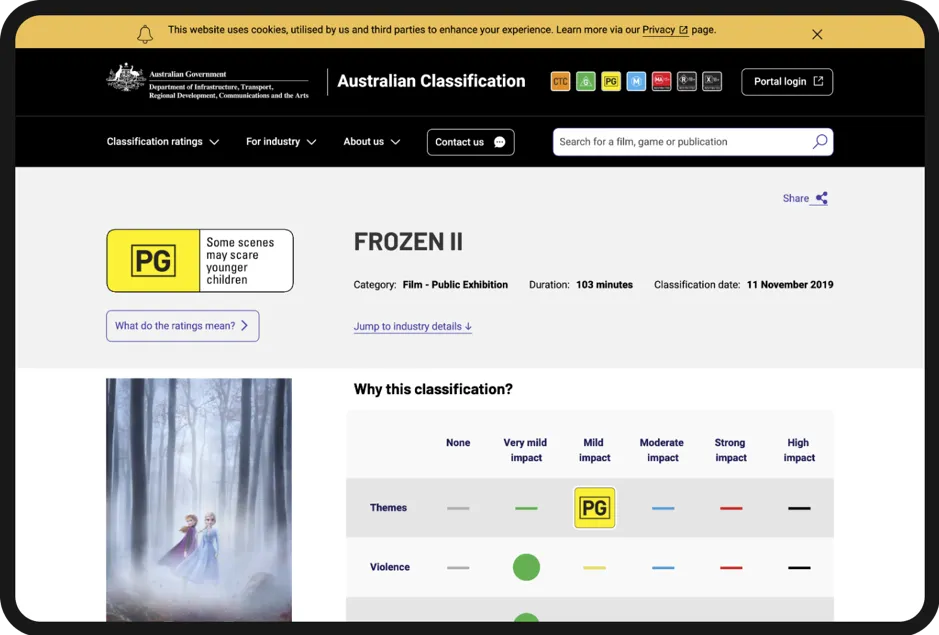
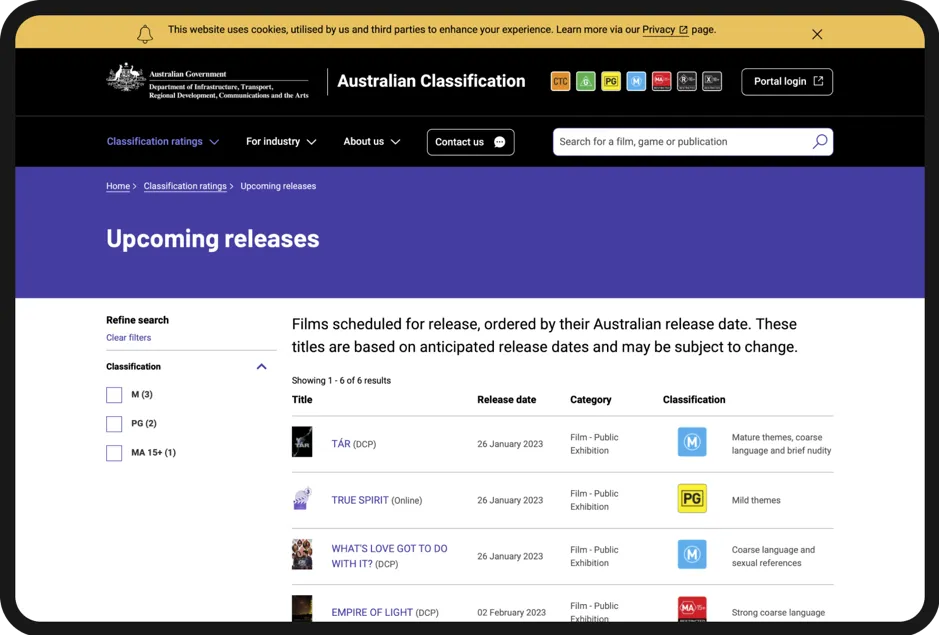
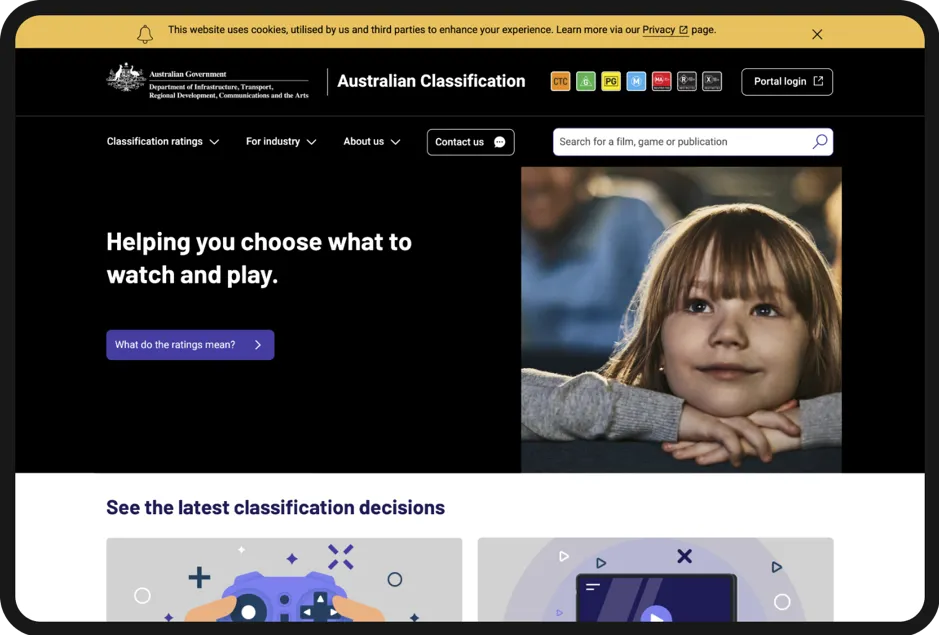
A team at Salsa Digital and the Department of Communications and the Arts worked closely to deliver a new classification.gov.au website on GovCMS 8 SaaS. The project focused on user needs (in line with the DTA’s Digital Service Standard) and re-using standard components from the Australian Government Design System. The new site delivers improved user journeys for citizens/parents and industry users.
About the project
Department of Communications and the Arts’ challenge
The Classification website was built on a proprietary CMS, Sharepoint. The site was last redeveloped 10 years ago. The CMS was dated, content was unstructured and duplicated, and didn’t comply with many current digital standards. The two primary audiences, citizens (most commonly parents) and industry users, had compromised user journeys. To solve these problems, DoCA was looking at bringing the Classification website across to GovCMS, using the DTA’s Digital Service Standard, and applying the DTA’s Australian Design System to ensure key usability and accessibility issues were identified and addressed.
Department of Communications and the Arts’ transformation
The first part of the solution was a three-day site assessment which identified 79 requirements and recommended GovCMS 8 SaaS, after considering each of these requirements in detail. Salsa Digital’s blog GovCMS Site Assessment for the Australian Movie and Games Classification Board - Classification provides details of this process. From there, the user research/user testing started, alongside the initial stages of the site build/migration and technical investigations.
The user research, and greater UX process, included:
-
Salsa Digital partnering with Today to deliver the user research/UX
-
Using paper-based models to quickly arrange combinations of the design system components
-
Defining key test scenarios for citizen/parent and industry users
-
Recruiting representative users for both industry and citizens/parents
-
Creating an interactive prototype
-
Conducting testing for both citizens/parents and industry
-
Compiling findings and key recommendations
-
Iterating designs based on findings to formulate a final design ready for build
The technical process included:
-
Building a proof of concept integration to a DoCA API to ingest title information (film, game and publication) from the National Classification Database (NCD)
-
Designing and catering for the ingestion of movie poster images using the same API
-
Working with GovCMS/Department of Finance to reach in-principle agreement for inclusion of required modules into GovCMS 8 SaaS
-
Migration of 1.8 million existing classification records into the new GovCMS site
-
Load testing the site with consideration of typical and peak numbers for new classifications and changes
The build process included:
-
Agreeing/compiling user stories as a backlog of functional requirements
-
Prioritising requirements and formulating a series of build sprints (eight sprints)
-
Building and testing each sprint, while planning the next sprint
-
Incorporating the work from the proof-of-concept API work (see above)
-
Running the new build, prior to live, in parallel with the existing build to validate important data requirements such as the display of latest classified titles and the search results
-
Planning and executing the live cutover
The outcomes
The benefits of the new classification.gov.au website include:
-
Hosting on GovCMS SaaS platform (Drupal) for security and site management
-
A new, visually appealing website
-
Site designs and features created in close consultation with user research and user testing for improved usability
Why Drupal was chosen
Drupal was chosen as the preferred CMS for Australia’s Federal Government through the creation of the GovCMS platform, which was launched in 2015. GovCMS is designed to make it easier for government agencies to create modern, affordable, responsive websites. Importantly, GovCMS provides a whole-of-government platform to help consolidation across government departments. The fact that Drupal is open source means there are no expensive lock-in contracts, and GovCMS can build a Drupal/GovCMS community.
Technical Specifications
Drupal version:
Key modules/theme/distribution used:
GovCMS was chosen as a mature, whole-of-government Drupal solution that was moving to a headless and static implementation.
As a SaaS project, we couldn’t add any modules onto the normal GovCMS offering. However, at the time the distribution was missing modules that we needed to import data feeds from their internal API, so they were requested to be allowed. That request was granted and we were able to add 4 additional modules (migrate_file, migrate_plus, migrate_source_csv, migrate_tools). Those 4 modules have since been added to the distribution, so the Classification website is currently running on SaaS without any modules outside of what GovCMS distro offers.