Sector(s)
Team Members
Project Team
In addition to listed team members:
- Robert Kitchen, AMA Project Manager
Visit the site
Visit the siteOrganizations Involved
Community contributions
Work on this project began when Drupal 8.4 was in alpha, so the team did a lot of work hashing out the install process for 8.4.
Patches and code contributions:
- [#2853044]
- [#2737773]
- [#2910257]
- [#2901348]
- [#2917207]
- [#2922014]
The project also resulted in a case study presentation at MidCamp 2018 and multiple new additions to the MidCamp organizing team.
Since 1847 the American Medical Association has promoted scientific advancement, improved public health, and invested in the doctor and patient relationship. Today, the AMA has a vision for a healthier America. Improving the health of the nation is at the core of the AMA's work to enhance the delivery of care and enable physicians and health teams to partner with patients to achieve better health for all.
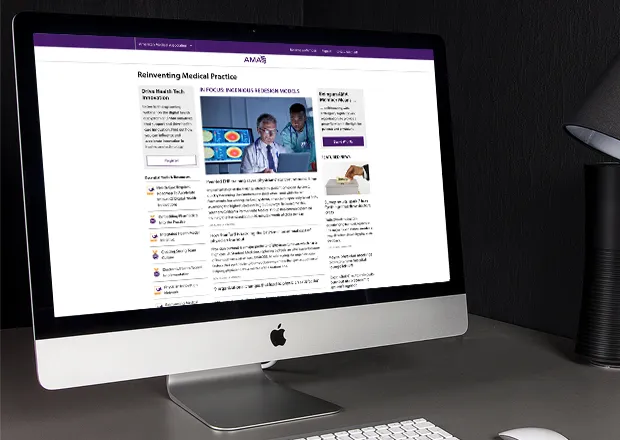
In mid-2017, the American Medical Association set out to create a “new digital experience” for physicians, residents, students, and patients by aggregating thematic content from across their properties into a single, focussed source. Their desired outcome was for business units to be able to create “hub” pages where articles from a variety of properties were just one click away.
In the words of Jef Capaldi, Director of Digital Programming Strategy, “With the goal of reinforcing the AMA’s significant impact on physicians and the practice of medicine, the digital publishing team collaborated with business units to define reader-friendly content areas that both demonstrate the AMA understands the challenges physicians face and that they are their powerful ally in solving these problems.”
To that end, the AMA UX team developed a number of content patterns which were to be populated and placed by the content team in flexible layouts. The AMA Digital Technology Team in partnership with Palantir.net were tasked with combining the UX vision and business goals into an editor-friendly CMS solution.
About the project
Since the publication of their Drupal 7 site in late 2016, the AMA identified that while expansion of their web initiatives had created a wealth of new content for their audiences, that content was also becoming more and more disparate across their properties (Drupal and otherwise). From Michelle Scannicchio, Director of Digital Analytics, “The purpose of the Topic Hub page is to drive membership purchase and retention over time by being a trusted resource on the topics that matter to members and prospects.” Those topics could be driven by any number of factors—medical students’ interests might be more focused around the academic year, yet doctors might be more influenced by news and current events. Underlying all of these issues, the AMA’s goal was to inform current members how they’re being supported in these topic areas, and to educate prospective members about the benefits of membership.
Much of the content in the initial version of the Topics project was to be meta-content — that is, a basic title, description, link, and optional image which would be combined into a link out to the source, whether that be on another Drupal property or external site. Displaying that meta-content with different display modes allowed content editors the flexibility to reuse content across many portions of their page. Custom blocks containing entity references were placed into custom layouts with the Panels In-Place-Editor, meaning that editors could have a true, block-level, WYSIWYG experience in creating each topic experience. Later phases of the project integrated automated feeds of meta-content from Drupal and non-Drupal properties via XML feeds, allowing editors to grab new posts even easier.
The first topic pages launched in late October 2017, and by the end of 2017, the AMA content team had published 6 topic pages. These pages were met with rave reviews from the internal stakeholders.
AMA Chief Experience Officer Todd Unger described the pages as “The best pages AMA has ever put on the web, and they’re even better on mobile.”
Members of the board and others expressed their satisfaction with the new topic-driven experience, and the content team was able to show the pages at their all-company town-hall, garnering interest from across the organization for creating hubs for many other topics.
Analytics numbers echoed the feedback. Visitors to these pages:
- spend 2x more time on AMA properties;
- view 2.8x more pages;
- are 20% more likely to begin the membership application process;
- interact more with AMA content, with a 2x smaller bounce rate.
Why Drupal was chosen
AMA had invested almost 2 years of work in Drupal for their main web property, https://www.ama-assn.org/, so Drupal was a natural choice for this project. Planning had already begun for a large-scale consolidation of the more evergreen content on www with the timely AMA Wire news and blog site, and Drupal 8 was the intended platform, so this project served as a pilot for testing out Drupal 8 and a number of its improvements. Flexible layouts, the streamlined content editor experience, deep migration integration, twig-based theming, and a improved config management workflow were all major draws for the AMA team.
Technical Specifications
Drupal version:
Key modules/theme/distribution used:
A full presentation on the build process for this site was given at MidCamp 2018. This project build focused on building flexible, reusable content layouts that were easily managed by content editors, and basing those layouts on a platform-agnostic pattern library which could eventually be used by other projects.
Drupal 8’s fully entity-based custom blocks formed the foundation of the layouts, with “Entity Reference + View mode” fields giving content editors even more flexibility on how their referenced content is displayed. Inline Entity Form brings the node edit experience right into the in-place editor. Drupal 8.4’s addition of Layout Discovery in core combined with a lightly customized Panels IPE allows editors to not only move content blocks around the page with full WYSIWYG functionality, but also choose between different layouts.
The first version of the theme was built by prototyping in Pattern Lab and then manually converting Pattern Lab twig into Drupal-consumable twig, but that process quickly became burdensome. With the addition of Layout Builder in Drupal 8.5 and the UI Patterns module, the team worked to more closely integrate their Pattern Lab to Drupal workflow.
Last but not least, Config Split made our dev and prod environments happy.