Sector(s)
Accessibility Standards Canada (ASC) is a federal departmental corporation established in 2019 under the Accessible Canada Act. Its mandate is to develop and revise accessibility standards that improve the quality of life, inclusion, and participation of people with disabilities across federally regulated sectors. These include government buildings, financial institutions, transportation systems, and other key public services.
ASC plays a critical role in shaping the regulatory framework that ensures physical, digital, and systemic accessibility in Canada. As such, its online presence is not only a communication tool but also a reflection of the very standards it seeks to implement across the country.
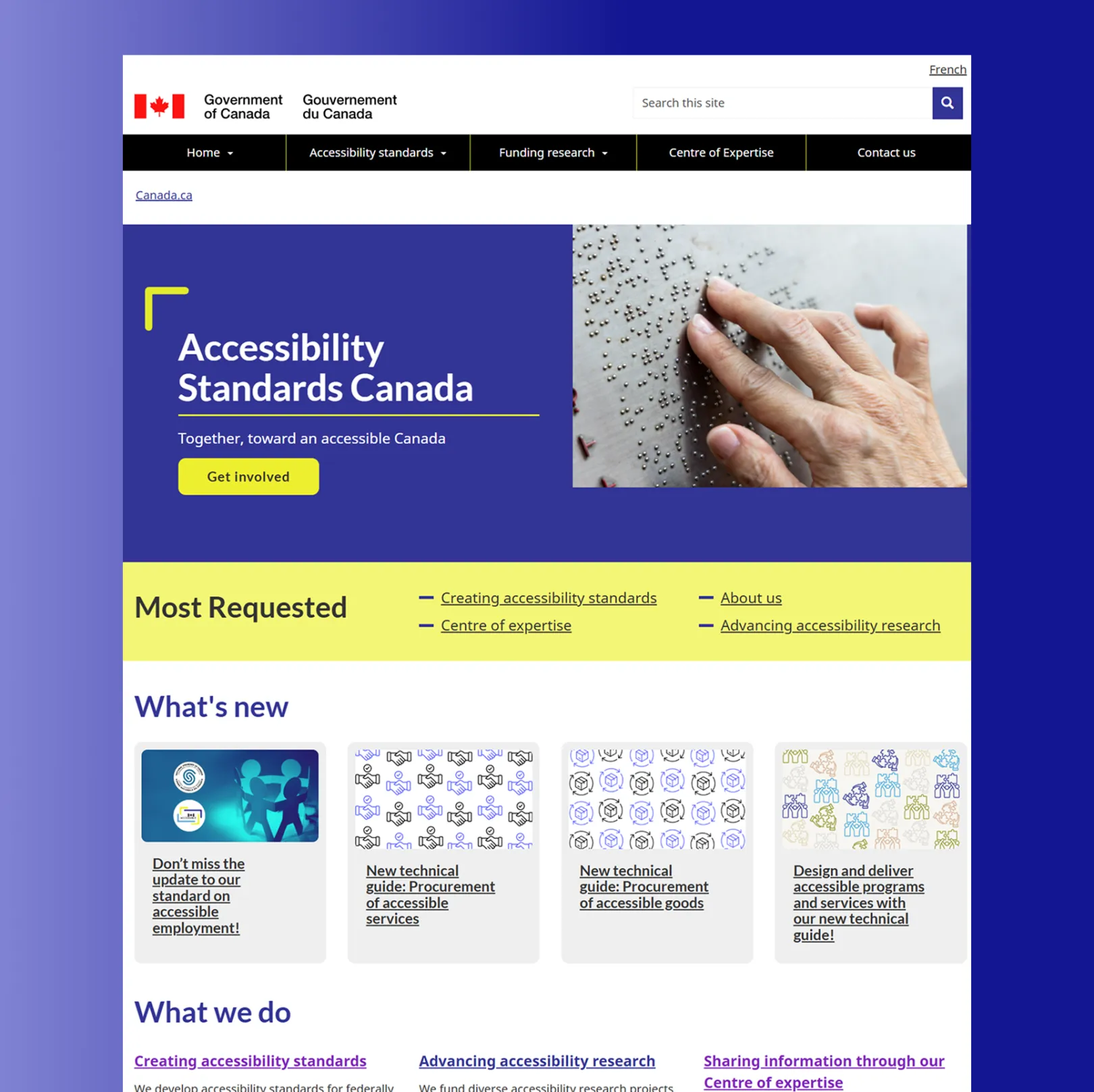
To align its digital presence with its accessibility mandate, ASC sought a complete redesign and rebuild of its website. The organization needed a platform that would be easy to navigate for diverse user groups—including people with visual, auditory, cognitive, and motor impairments—while also meeting federal compliance standards.
About the project
People with disabilities often rely on assistive technologies such as screen readers, screen magnifiers, voice recognition software, and alternative input devices (like switch controls or eye-tracking systems) to navigate the web. These tools help transform digital content into speech, braille, enlarged visuals, or other accessible formats so users can interact with websites effectively. ASC wanted to ensure that its’ website was the most accessible it could to ensure that people using these technologies could digest all the information and resources on the site. The project involved:
- A full redesign of ASC’s website with accessibility as the core design principle.
- Configuration of the Drupal 11/WxT core a various modules
- Custom development of key Drupal modules to support accessible display and consumption of the standards
- Deliver a more intuitive, compliant, and modern user experience
- Improvement of the site’s information architecture.
- Implement a publishing workflow that allows internal content teams to ensure quality and compliance.
Accessibility-Focused Design and Development using Drupal 11
The team started the project by conducting in-depth research with users that use assistive technologies and created user profiles and user journeys. They led UI/UX workshops to develop wireframes and high-fidelity responsive designs. They customized the theme to align with ASC branding while ensuring compliance with government standards. Finally, they created a fully WCAG 2.2-compliant front end.
The team designed the technical architecture and created a multisite environment. The team migrated and validated legacy content using both manual and scripted approaches. They configured Drupal workflows and permissions to enable self-publishing within a controlled framework. They also integrated search enhancements, social media modules, and extended security modules to meet federal standards.
They oversaw the Pantheon deployment, which included implementing a global application firewall and load-balanced containers. They also managed version control and guided site evolution through GitHub.
To ensure the highest levels of accessibility, the team did extensive testing using accessibility tools such as JAWS Screen Reader, W3C validation tools, aXe accessibility extension, Wave accessibility toolbar, CSE HTML Validator, and SortSite. They also worked with representatives of the accessibility community to see this group feedback on the user experience. And lastly, they also worked with the Government of Canada’s AAACT group (Accessibility, Accommodation and Adaptive Computer Technology) to continuously improve site accessibility.
One of Canada’s Most Accessible Sites
The new ASC website is recognized as one of the most accessible web sites in Canada, with usability testing by stakeholders and accessibility advocates confirming significant improvements. The accessibility community praised the redesign for its enhanced navigation, readability, and user flow. The AAACT confirmed that the site was the only at the federal level to fully meet WCAG 2.2, demonstrating a near-perfect implementation. Beyond accessibility, the site’s custom workflows and scalable infrastructure have streamlined operations, enabling the ASC team to maintain the platform with minimal problems.
Why Drupal was chosen
Fully Accessible, Cloud-based and Government-Ready
Drupal 11 was selected as the CMS platform for ASC’s digital transformation for several strategic reasons:
- Government-Ready: Drupal’s Web Experience Toolkit (WxT) distribution is specifically designed to meet the Canadian government’s standards for accessibility, usability, and interoperability.
- Accessibility by Design: Drupal’s modular architecture and flexible theming support conformance with the web accessibility standards WCAG 2.1 and 2.2, as well as compliance with the Official Languages Act and other Government of Canada web guidelines.
- Cloud-Enabled Scalability: The solution was deployed via Pantheon, a secure, cloud-based infrastructure used by the Government of Canada, offering high availability, load balancing, and enterprise-level security.
- Extensibility: Drupal’s robust ecosystem allowed integration of key modules such as extended search, social media sharing, enhanced security, and workflow management.
DrupalBliss was chosen by ASC thanks to its award-winning approach to web development, the team's extensive experience in Drupal (as well as with the Government of Canada’s WxT distribution), and due to their deep knowledge of web accessibility standards.
Technical Specifications
Drupal version:
Key modules/theme/distribution used: