Sector(s)
Project Team
- Development & Architecture: JAVALI's Drupal team
- UX & Design: JAVALI
- Project Management: JAVALI
- Client Coordination: IEM – NOVA FCSH
Visit the site
Visit the siteOrganizations Involved
Community contributions
The project reinforces Drupal as a strong foundation for academic research platforms, demonstrating its ability to manage complex datasets and advanced search.
The migration approach and modular configuration serve as an internal reference for future projects and highlight Drupal as a reliable technology for open-access scholarly repositories.
About the client
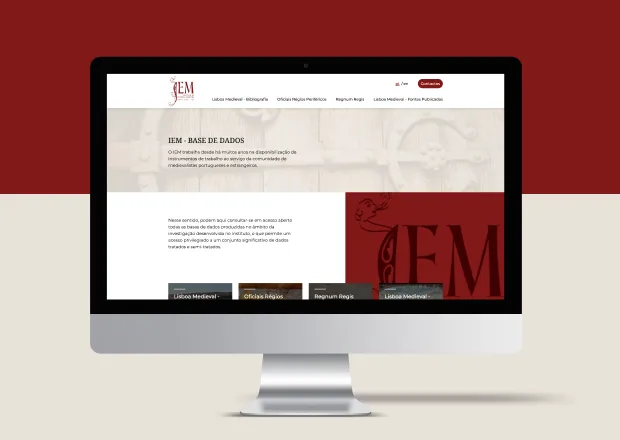
The Institute for Medieval Studies (IEM), part of the School of Social Sciences and Humanities of NOVA University Lisbon (FCSH), maintains several scholarly databases central to historical research.
These collections bring together bibliographic, documentary and administrative sources essential to the study of Medieval Lisbon and the Portuguese monarchy.
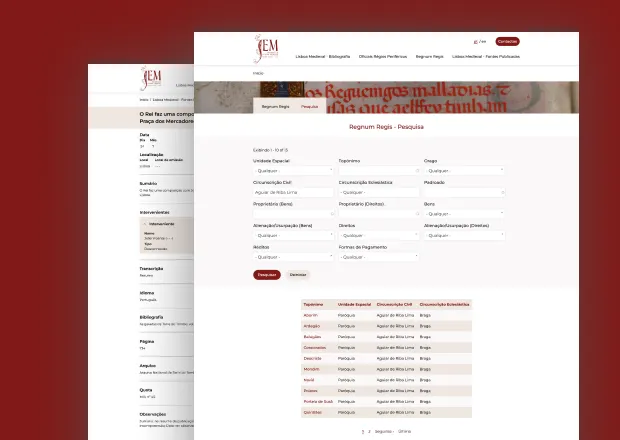
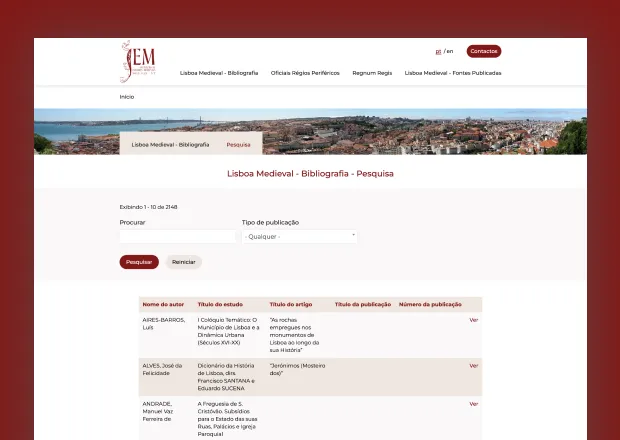
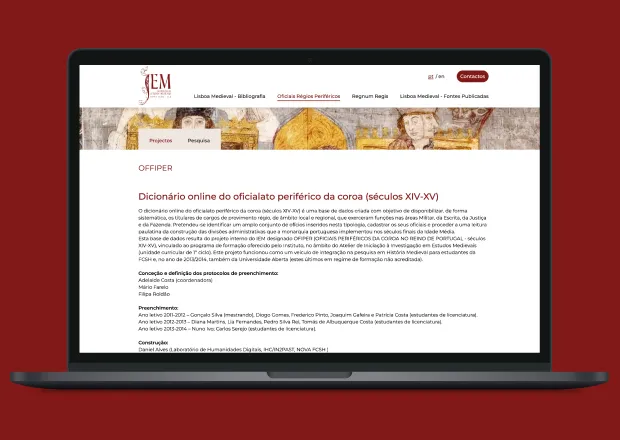
The new platform provides open access to all databases, offering a clearer, faster and more consistent experience for researchers, students and the general public.
About the project
Goals
- Modernize the entire platform with stable, secure technology;
- Ensure full data migration without losses;
- Improve usability and simplify content exploration;
- Provide a PT/EN multilingual interface;
- Offer an intuitive editorial backoffice for the IEM team;
- Maintain the depth, structure and specificity of the four research databases;
- Ensure full compatibility with mobile devices and major browsers.
Requirements
- Complete migration of legacy datasets;
- Modular architecture prepared for future database additions;
- Simplified editorial workflows and configurable permissions;
- Automatic translation workflows using JAVALI’s modules (Auto Bulk Translations + Auto Node Translate);
- Advanced search and cross-filter features;
- Integration of distinct metadata models and typologies;
- Accessibility-first and mobile-first design.
Outcome
The new Drupal 10 platform is faster, clearer and easier to use. It centralizes all datasets under a unified structure and delivers:
- Open access to validated academic content;
- Intuitive navigation with improved filters and cross-searching;A
- A stable environment with fully preserved historical data;
- Total editorial autonomy for the IEM team;
A future-proof system ready for new databases and functionalities.
Why Drupal was chosen
The previous portal showed structural and technical limitations and required a complete modernization. Drupal was chosen due to its:
- Long-term stability and sustainability;
- Strong capabilities for handling complex, structured datasets;
- Native multilingual support for PT/EN;
- Flexible content modeling suited for academic research repositories;
- Mature ecosystem for search, filtering and metadata management;
- Robust editorial workflows and permission models;
- Proven reliability for open-access research platforms.
Drupal guaranteed a future-ready solution capable of supporting academic use cases and evolving requirements.
Technical Specifications
Drupal version:
Key modules/theme/distribution used: