Sector(s)
Team Members
Project Team
Project manager: Gareth McWilliams
Developer: Dimitris Spachos, Joëlle Symons, Luqmaan Essop
Design: The Holcim Awards team
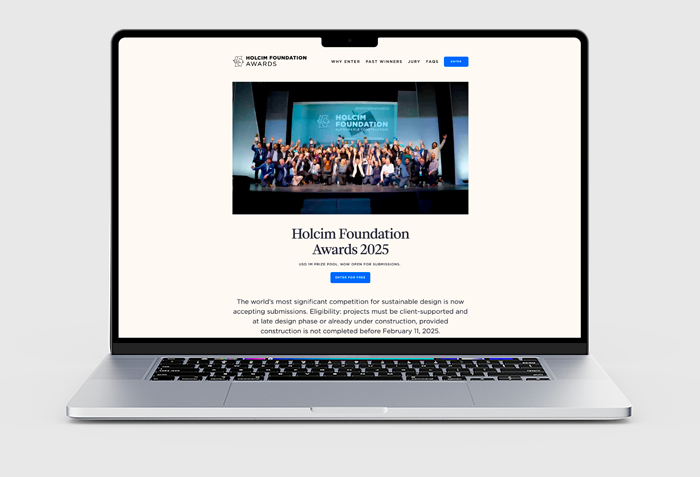
The Holcim Foundation Awards is the world’s leading competition for sustainable design. It invites submissions from client-supported projects in late design phases or under construction, provided the construction completion date is after February 11, 2025. The competition celebrates innovation in sustainable design and architecture, featuring a rigorous evaluation process to recognize projects that align with the Foundation’s commitment to environmental, social, and economic sustainability.
To facilitate this global initiative, a robust digital platform was required—capable of handling everything from project submissions to multi-round evaluations by an international jury. The resulting application provides an intuitive front-end microsite for user engagement and a sophisticated back-end system for submission, evaluation, and administration.
About the project
Goals
The Holcim Foundation sought to create a digital platform that would streamline the management of its prestigious awards program while ensuring a seamless experience for all stakeholders.
-
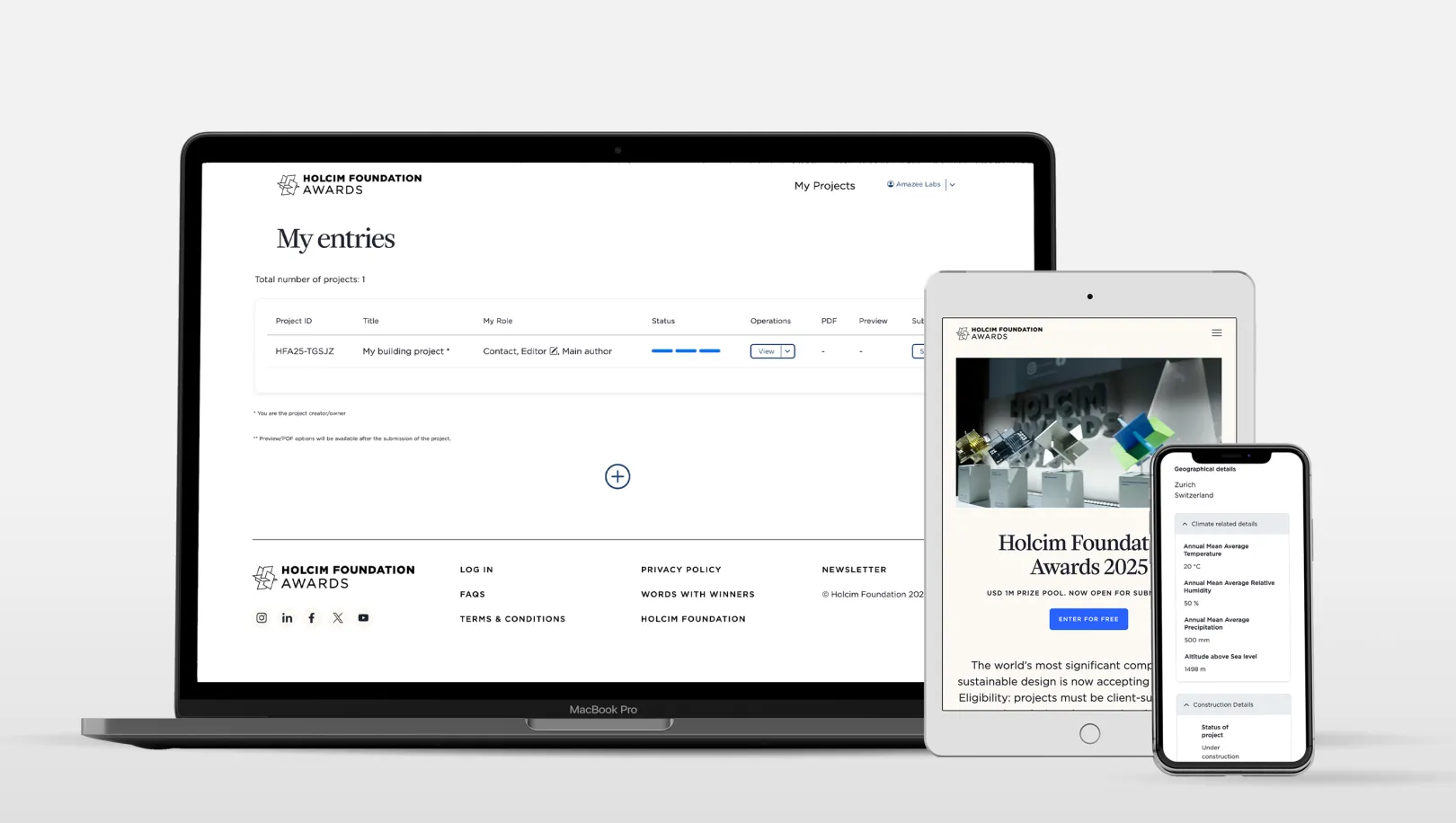
For Participants: The platform needed to provide a user-friendly interface for applicants to register, create, and submit their project applications. These applications required users to input detailed project data, upload supporting documentation, and meet strict contest requirements. The aim was to simplify the process without compromising on the depth and quality of information collected.
-
For Evaluators: Jury members needed an intuitive and efficient interface for reviewing, scoring, and ranking submissions across multiple evaluation rounds. The platform had to ensure that evaluators could access all relevant information quickly, focus on their scoring criteria, and collaborate with other judges effectively throughout the process.
Requirements
The platform was designed to address a complex set of functional and technical needs:
-
Role Management and Workflows: The platform had to accommodate multiple user roles, each with distinct permissions and workflows. These roles included project creators, evaluators, note-takers, and administrators. Ensuring strict role-based access controls and user experiences tailored to each group was critical. For example, evaluators could access projects only in their assigned round and category, while administrators needed comprehensive oversight and control over the competition’s parameters.
-
Structured Registration Process: A strict registration workflow was implemented to ensure that all users—whether submitting projects or serving on the jury—met the competition’s standards. This process needed to integrate data validation, approval mechanisms, and secure user authentication seamlessly.
-
Dynamic Form Creation and Data Handling: Submissions involved large, complex forms that allowed applicants to detail project goals, methodologies, and outcomes across various sustainability criteria. The platform had to efficiently store and manage this data while providing a responsive and error-free user experience.
-
PDF Generation for Submissions: A core requirement was the ability to generate detailed, dynamic PDFs for each project submission. These PDFs, containing all project details and attachments, were to be distributed to evaluators for offline review and record-keeping. The PDFs had to be visually consistent, easily shareable, and formatted for professional use.
-
Evaluation Management: The multi-round evaluation process required functionality for jurors to score projects across several criteria, rank submissions, and identify top candidates. Projects that met dynamic thresholds would advance to subsequent rounds, and the platform needed to support adjustments to these criteria as the competition progressed.
Outcome
The result was a robust, efficient platform that facilitated the Holcim Awards competition from start to finish.
-
End-User Experience: Participants were provided with an intuitive interface to easily register and submit projects, significantly reducing potential friction in the application process. The use of structured forms and clear workflows ensured high-quality submissions.
-
Streamlined Evaluation: Evaluators benefited from a responsive, user-friendly dashboard that allowed them to access, review, and score submissions efficiently. Automated workflows and real-time project filtering enhanced the decision-making process.
-
Operational Efficiency: Administrators could dynamically configure competition parameters, manage roles, and oversee the entire process with minimal technical intervention. The automated PDF generation and scalable architecture made it easy to support a large volume of submissions and evaluations.
-
Scalability and Performance: The platform’s architecture ensured smooth performance even with high user activity during key periods, such as submission deadlines and evaluation phases.
In summary, the platform delivered on all goals and requirements, establishing a solid foundation to conduct the Holcim Awards seamlessly while upholding the competition’s global reputation for excellence.
Key Features
The platform for the Holcim Foundation Awards seamlessly integrates several advanced features that cater to the needs of participants, evaluators, and administrators while maintaining high performance and flexibility. Below are the key features that made the project a success:
1. Microsite Built on Top of a Web Application
A user-friendly and visually engaging microsite was developed as the front-facing portal for the competition. This microsite:
-
Served as the entry point for applicants, evaluators, and administrators.
-
Presented a clean, intuitive design aligned with the Holcim Foundation's branding.
-
Provided clear navigation and access to essential information about contest rules, eligibility, and submission requirements.
-
Integrated seamlessly with the underlying web application, ensuring a smooth transition between static content and dynamic application workflows.
The microsite's focus on usability and accessibility ensured that users, regardless of technical skill, could interact effectively with the platform.
2. ActiveCampaign Integration
The platform integrates with ActiveCampaign, a powerful marketing automation tool, to enhance communication and engagement:
-
Automatically syncs user data (e.g., registration information) and project submission details to enable targeted outreach.
-
Supports personalized email campaigns for different user roles, such as sending reminders to applicants about submission deadlines or notifying evaluators of upcoming tasks.
-
Tracks user interactions and automates follow-ups, ensuring all stakeholders stay informed and engaged throughout the competition lifecycle.
This integration streamlined communication, reducing administrative overhead while enhancing user experience.
3. Complex PDF Generation from Submitted Entries
A robust PDF generation feature was implemented to create comprehensive, high-quality documents for each project submission:
-
Each PDF contains all submitted data, including text, images, and other supporting materials, formatted consistently for easy review.
-
PDFs are dynamically generated to reflect updates or changes in submissions, ensuring that the latest information is always available to evaluators.
-
The feature is optimized for large-scale generation to handle the volume of submissions expected in a global competition.
This capability ensured that evaluators had access to well-structured, professional-quality documentation for offline review or archival purposes.
4. Custom Modules and Services for Contest Management
To support the unique workflow of the Holcim Awards, several custom Drupal modules and services were developed, addressing the following key functionalities:
-
Custom Workflow Management: Configurable workflows for submission, evaluation, and progression through multiple contest rounds.
-
Dynamic Notifications: Automated email and in-platform notifications for key actions, such as successful submission, evaluation deadlines, or advancing to the next round.
-
Registration Management: A strict registration workflow tailored to different user roles, ensuring data accuracy and security.
-
Media Uploads: Support for uploading and managing high-resolution images, videos, and other media assets required for project submissions.
-
Advanced Form Handling and Validation: Custom forms with complex validation rules to ensure applicants meet all contest requirements. These forms were user-friendly yet robust enough to handle detailed project information.
The development of these custom modules ensured that the platform could cater to the specific and evolving needs of the competition, while leveraging Drupal's extensibility.
Together, these features created a powerful, scalable solution that met the Holcim Foundation's requirements while providing a superior user experience for all stakeholders involved.
Why Drupal was chosen
Drupal was selected as the foundation for this project due to its unmatched ability to function as both a content management system (CMS) and a web application framework. The platform needed to accommodate complex workflows for project submission and evaluation, while ensuring scalability and flexibility.
Key reasons for choosing Drupal:
-
Powerful Entity and Form API: The competition required dynamic, customizable forms for project submissions, with the ability to store and manipulate large volumes of structured data. Drupal’s Entity API and Form API offered a seamless solution.
-
Custom Workflow Management: The evaluation process involved multi-tiered scoring, ranking, and filtering based on dynamically defined thresholds. Drupal’s workflow capabilities allowed for the creation and management of this intricate process.
-
Administrative Flexibility: Administrators needed the ability to modify thresholds, scoring criteria, and evaluation rules dynamically. Drupal's modular architecture provided a scalable framework for these requirements.
-
Open Source and Community Support: As an open-source platform, Drupal offered the flexibility to customize solutions while leveraging an active community for ongoing innovation and support.
In summary, Drupal provided the right combination of features, flexibility, and scalability to meet the Holcim Foundation's ambitious goals.
Technical Specifications
Drupal version:
-
Database: MariaDB/MySQL
-
Web Server: Nginx
-
Front-End Framework:
-
Twig templating engine for theme development
-
Responsive, mobile-first design using modern CSS frameworks (e.g., Bootstrap)
-
-
Authentication and Security:
-
Role-based access control (RBAC)
-
Secure HTTPS with SSL/TLS encryption
-
-
Modules:
-
Custom modules for contest workflows, notifications, and media uploads, ActiveCampaign integration, PDF export, and user management
-
-
Caching and Performance:
-
Drupal core caching system with support for external caching solutions like Redis
-
Optimized asset delivery using CDN integration
-
-
DevOps and CI/CD:
-
Composer for dependency management
-
Continuous deployment pipelines using GitHub Actions
-
Custom Node.js PDF Application Specifications
-
Framework: Node.js (LTS version 18.x)
-
PDF Library: Puppeteer for headless Chrome-based PDF generation
-
Server: Express.js for building the API endpoints
-
Data Exchange: JSON-based API for integration with Drupal
-
PDF Features:
-
Dynamic layout generation using HTML/CSS
-
Embedding high-resolution images, graphs, and charts
-
Multi-page support with headers, footers, and watermarks
-
-
Authentication:
-
Token-based authentication
-
IP whitelisting for secure API access
-
-
Performance Optimization:
-
Efficient handling of concurrent requests using Node.js asynchronous architecture
-
Time-based caching of generated PDFs
-
-
Error Handling: Centralized error logging with Winston or similar libraries
-
Deployment:
-
Containerized using Docker for consistency across environments
-