Sector(s)
Project Team
Daniel Schurman, Project Manager
John Goldring, Project Manager
Rob Ashley, Developer
Matthew Wheelock, Developer
Kevin Huff, Developer
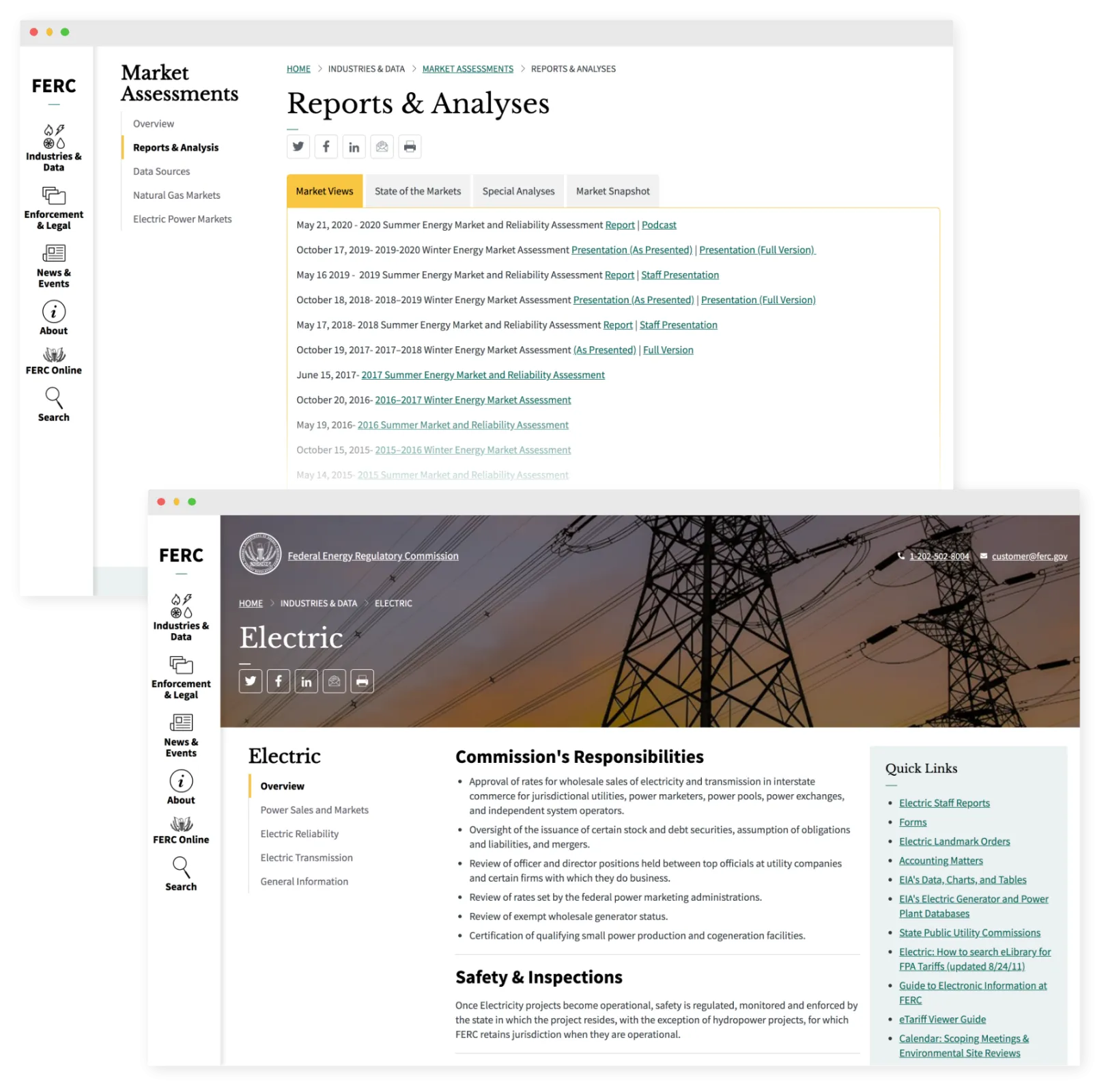
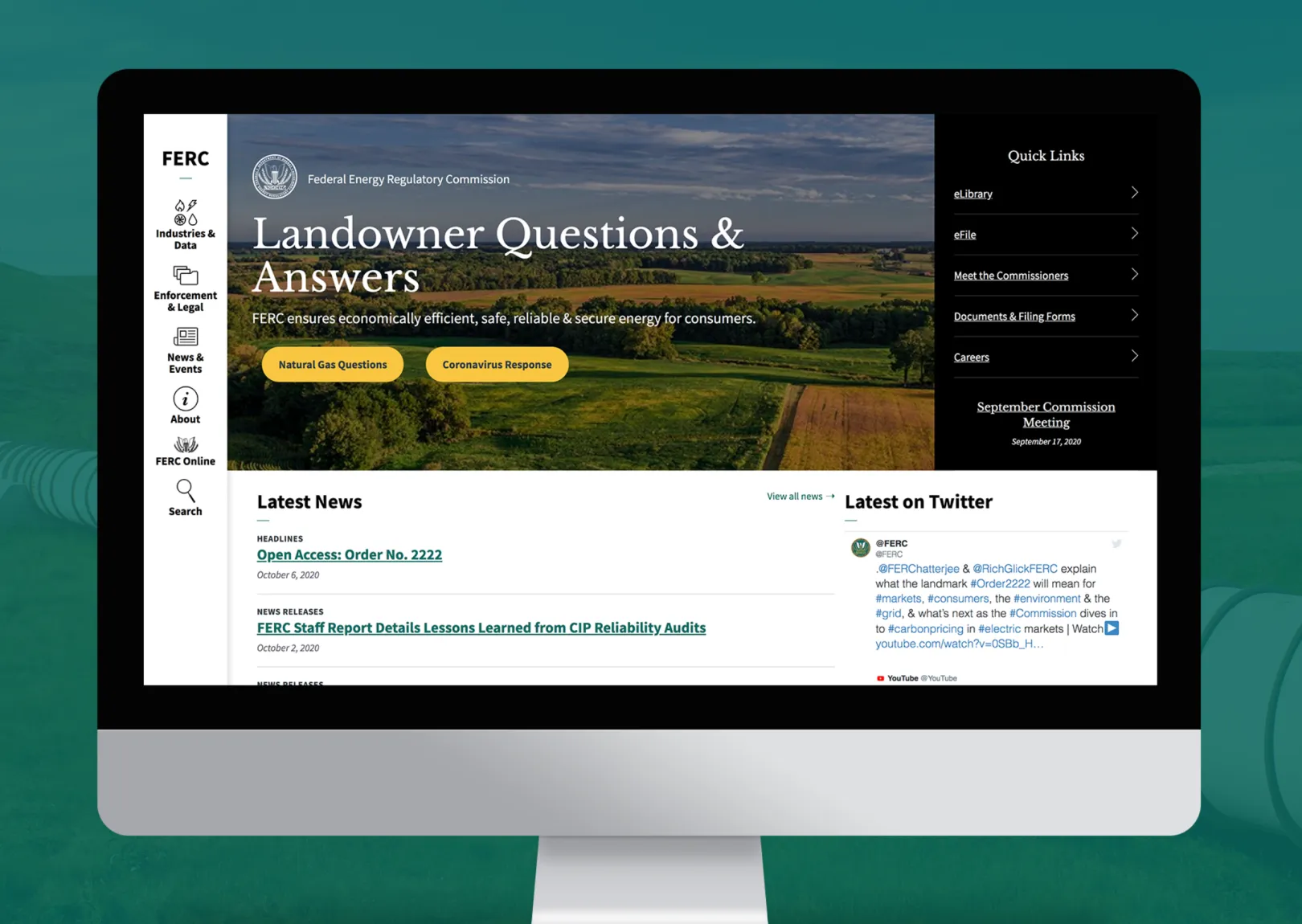
Mobomo transformed FERC’s antiquated, static site to a mobile friendly, responsive, and user-friendly resource.
About the project
Goals: As part of a larger technology modernization effort, the Federal Energy Regulatory Commission (FERC) enlisted Mobomo to perform the upgrade of its website from an antiquated Dreamweaver/file system management solution to a modern cloud-based Drupal CMS. Mobomo worked with FERC stakeholders to deliver a vastly improved, user-friendly, mobile responsive website (ferc.gov) built on a modern technology stack using the open-source Drupal framework on the Azure PaaS.
As part of a second phase of its digital modernization strategy, FERC has continued to enhance the platform’s capabilities and resilience. In 2024, the agency explored new ways to improve searchability and access to its extensive repository of regulatory filings, orders, and public documents. Mobomo supported this effort by identifying options to integrate AI-enhanced search capabilities into the existing Drupal platform. While this initiative remains in the planning stage, it reflects FERC’s long-term vision for a more intelligent and accessible user experience.
In parallel, the team prioritized concrete advancements in security and performance. In 2025, FERC implemented a global content delivery network (CDN) and caching strategy using Cloudflare. This integration enhances the site’s scalability and response times while providing critical protection against distributed denial-of-service (DDoS) attacks and other malicious threats. Leveraging Cloudflare’s advanced features, including a Web Application Firewall (WAF), bot mitigation tools, and SSL/TLS encryption, Mobomo significantly improved the site’s overall security posture, delivering a more resilient, reliable, and performant experience for both public users and internal stakeholders.
Requirements: Mobomo was contracted to deploy our CMMI Dev Level 3 Agile software development process in the delivery of a high-quality system. Given that FERC needed to modernize from a completely static site, our team recommended utilizing a containerized structure. Leveraging best practices from the US Digital Services Playbook and CSPs including Cloud Architecture Frameworks and the Twelve-Factor App Methodology, we implemented an “Everything-as-Code” and Infrastructure-as-Code (IaC) strategy. We performed a high-volume data migration of 166,000 static pages of content, data, and documents. During development we employed regular two-week development sprints integrated with client demos, usability, 508, and security tests. We employed Azure DevOps for its Agile Continuous Integration and Continuous Delivery (CI/CD) methodology to automate builds and configuration management. Our processes were fully compliant with FedRAMP, FISMA, and ongoing technical security management of the FERC environment. The team developed scripts for automated code testing, which significantly reduced the amount of time required for quality assurance (QA) during the development process. Additionally, we automated the testing code to keep the development team lean and enable rapid detection and remediation of any bugs prior to delivery of milestones to the customer.
Outcomes: Uncovering user needs was integral to the creation of a simple, intuitive, user-centric experience. The Mobomo team held weekly design meetings to gather requirements, propose ideas, and ensure that the transformation of the system aligned with specified mission goals. We created a plan, associated testing scripts, employed usability testing tools, and provided result reports to FERC stakeholders and the Product Owner. Wireframes were used to walk them through potential ideas. Site maps and data models were created using tools like open card sorts to consolidate and simplify the IA and to apply industry best practices in modernizing FERC’s content storage and use of search tools and external applications (eLibrary). Clickable prototypes were used to test usability. Results of this research led to final approved standard designs (style guide, components library, and templates). For each task, we defined goals, objectives, and target audience with key stakeholders.
With the transformational work that has been done on the FERC site, it is now a responsive and user-friendly website built on a modern technology stack using the open-source Drupal framework on the Azure PaaS. The system also needed to support flexible permissions and complex publishing workflows across different user types. These enhancements had to align with FERC’s stringent standards for accessibility, security, and performance.
Why Drupal was chosen
The client had used Drupal previously and was very happy with the functionality and reliability.
Technical Specifications
Drupal version:
Key modules/theme/distribution used:
These modules met client needs, are well maintained and are commonly used.